 Humably
Publications
The Capably Human research library
A growing library of frameworks, models, reports, guides, books, and instruments from Capably Human, connecting established research to the Capability Fitness framework and human capability in the age of artificial intelligence.
- Publications
- 8
- Types of work
- 5
- PDF editions
- 5
- Books
- 2
Browse the Library
Every publication, by type
Frameworks define the territory, models map it, reports measure it, guides turn it into practice, books take it to a wider readership, and instruments put it to work. Each one connects back to the Capability Fitness framework.
Articles, briefs, and essays are in the stream, at Articles.
8 publications
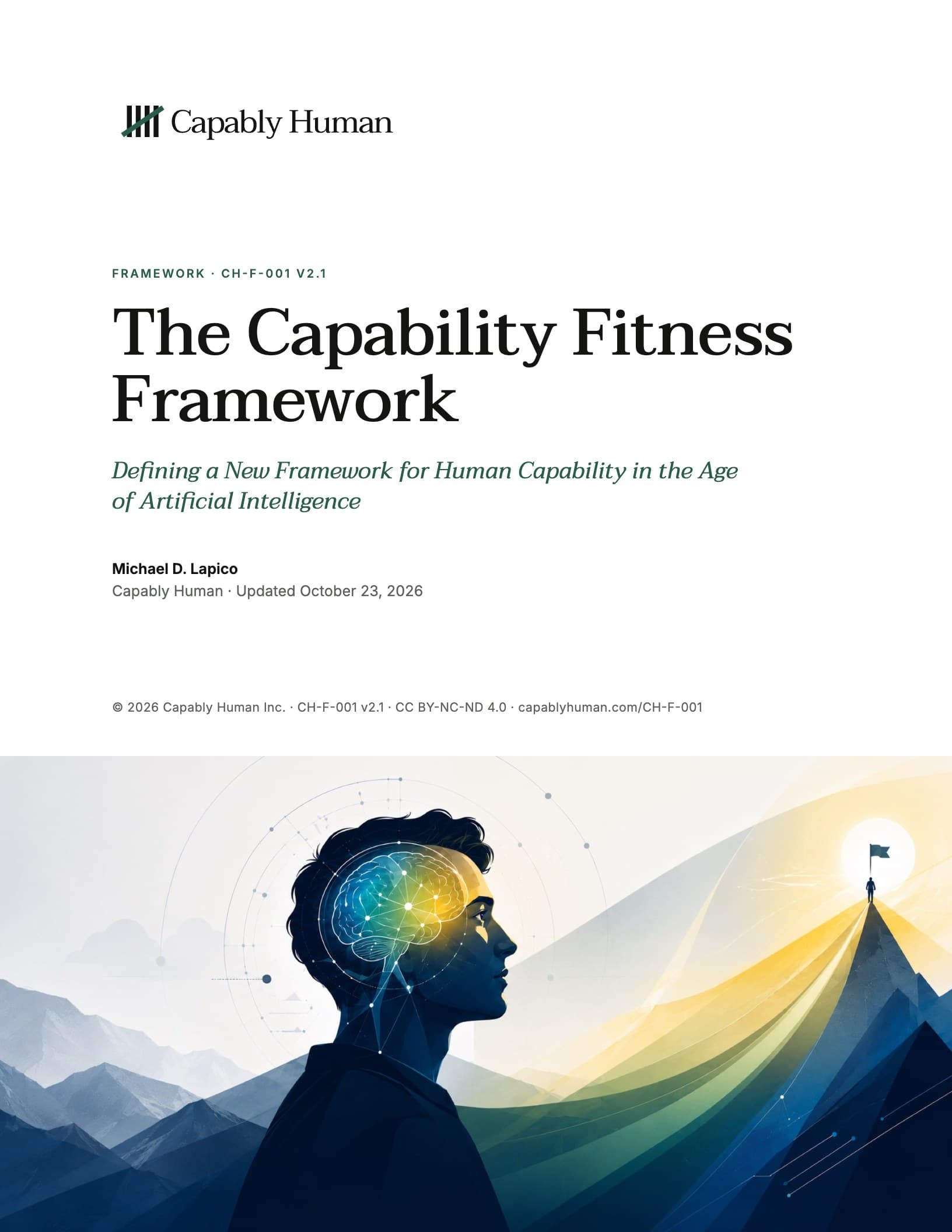
FrameworkCH-F-001 v2.1 July 3, 2026 40 min read
The Capability Fitness Framework
Michael D. Lapico
Capability Fitness is the lifelong development and maintenance of the capabilities of the mind that enable people to reason and decide, learn, focus, create, and adapt. The framework explains why AI makes this work urgent, introduces the five capability domains and their twenty-six sub-skills, the support-versus-substitution distinction and the eight Human-Strengthening AI principles, and sets measurement guardrails.
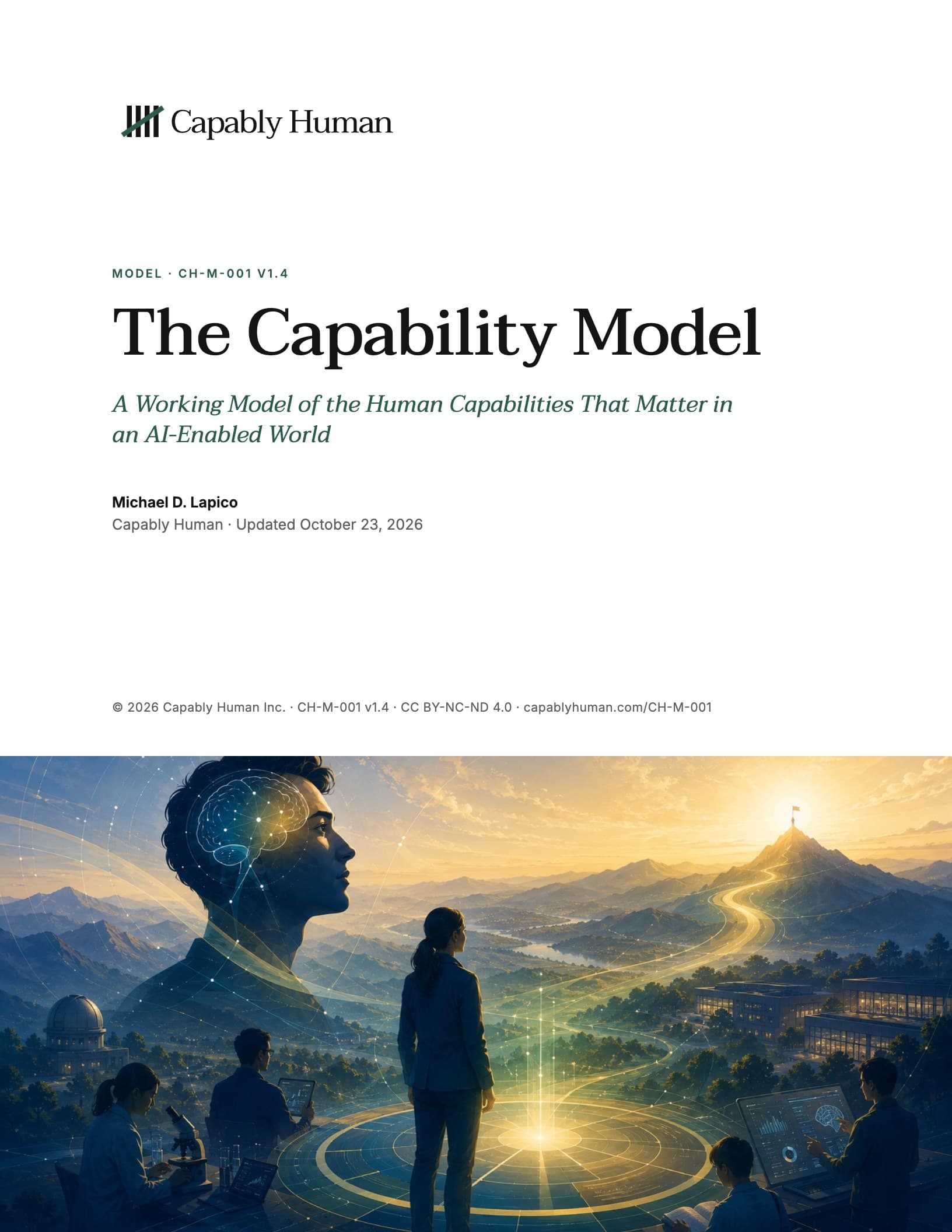
PublishedReadModelCH-M-001 v1.4 July 10, 2026 30 min read
The Capability Model
Michael D. Lapico
A developmental model of the human capabilities most affected by how people work with AI, organized into five domains (Think, Learn, Focus, Create, Adapt) and twenty-six observable sub-skills, each developed along a four-level scale from prompted performance to independent transfer. Every sub-skill carries a characteristic AI failure mode, and the model is the base for Capably Human's rules of engagement for human-AI interaction.
Builds on CH-F-001
PublishedReadGuideCH-G-001 v1.2 July 14, 2026 20 min read
Designing for Capability
Michael D. Lapico
Every feature teaches its users a pattern of practice, and practice is how capability is built or lost. This guide turns The Capability Fitness Framework and The Capability Model into working rules for product design and UX: the support-versus-substitution decision, eight design principles with techniques, a five-domain review lens, transfer-first metrics and a ten-question capability design review.
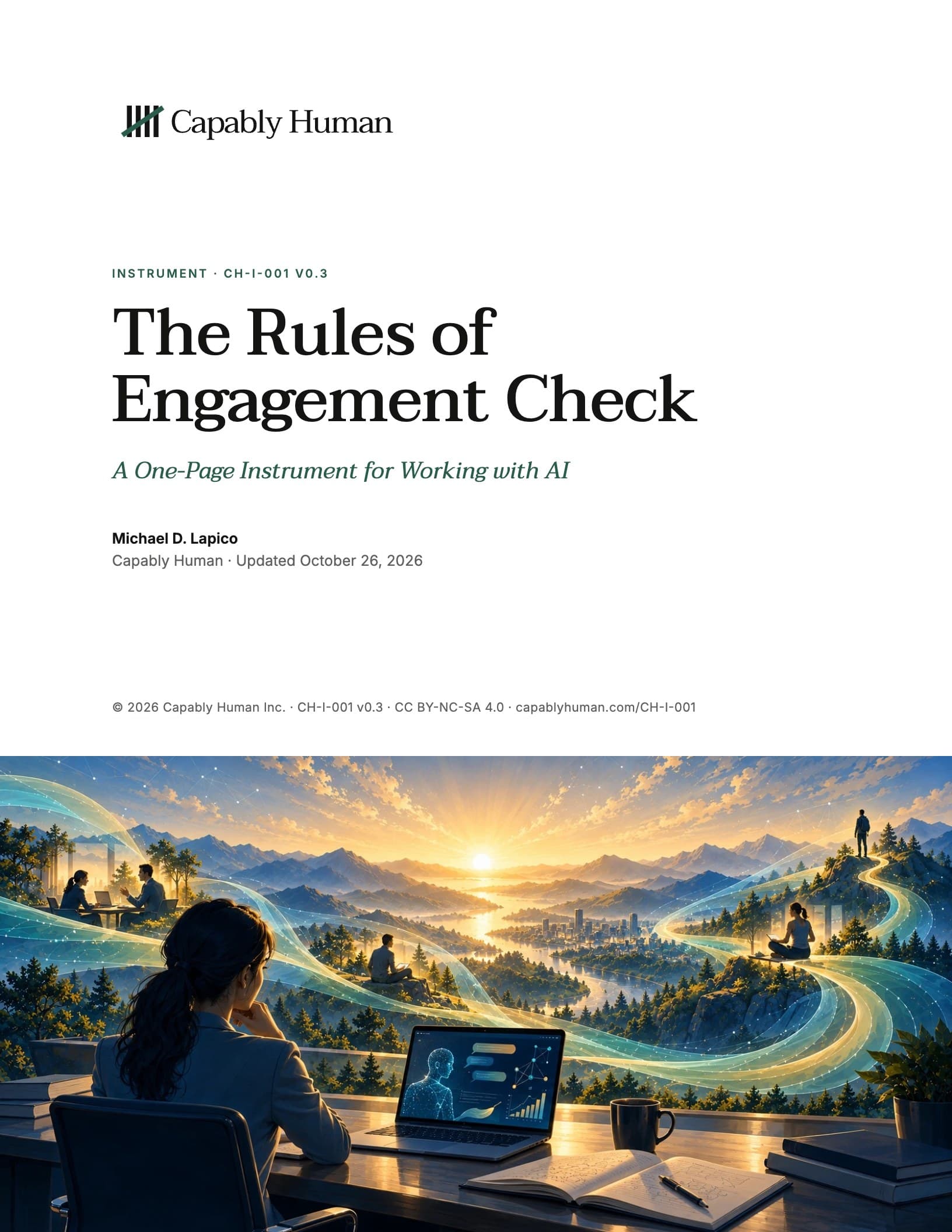
PublishedReadInstrument · WorksheetCH-I-001 v0.3 October 26, 2026 4 min read
The Rules of Engagement Check
Michael D. Lapico
A one-page check to run on any task before you hand it to AI, and again when the work comes back. It walks the three rules of engagement for working with AI (Delegate or Retain, Trust or Challenge, Let it run or Step in), each tested by one question: does the help support your effort or substitute for it? Nine questions, three calls, no score. The first instrument in Capably Human’s rules-of-engagement stack, and the check Humably runs with you on your own work.
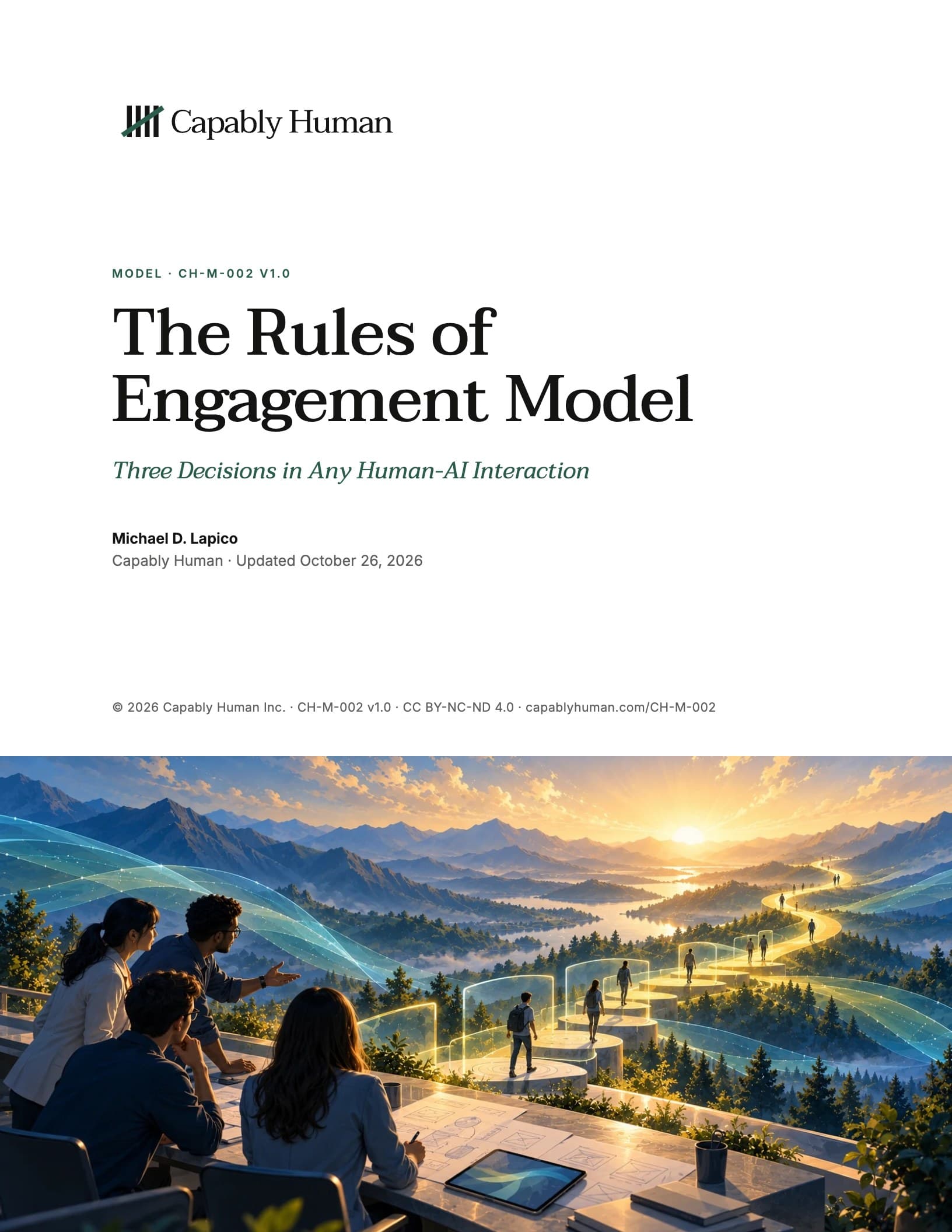
PublishedReadModelCH-M-002 v1.0 October 26, 2026 23 min read
The Rules of Engagement Model
Michael D. Lapico
A model of the three decisions that shape whether working with AI builds a person’s capability or substitutes for it: Delegate or Retain, Trust or Challenge, and Let it run or Step in, each tested by support versus substitution. It names what drives each decision, defines the engagement call as the observable unit of the practice, maps the calls onto the Capability Model’s proficiency scale and failure modes, sets out how they are observed and recorded in the delegation map, and states the hypotheses the trial program will test. The conceptual base for the Rules of Engagement Check (CH-I-001), the Rules of Engagement Guide (CH-G-002), and Humably.
PublishedReadGuideCH-G-002 v1.0 October 26, 2026 26 min read
The Rules of Engagement Guide
Michael D. Lapico
The long version of the rules of engagement, for people. It takes each of the three rules (Delegate or Retain, Trust or Challenge, Let it run or Step in) in turn: the decision, the questions that settle it, the signs it has gone wrong, and worked examples at work, at school, and in later life. Then the test in both directions, the rules by setting, eight common situations and the calls, how to practise, and three questions for managers, teachers, and parents to ask instead of “did you use AI?” Expands the one-page check (CH-I-001) and applies the model (CH-M-002).
Builds on CH-F-001, CH-M-001, CH-M-002, CH-I-001
PublishedReadBookCH-B-001 1st edition 17 chapters
Heavy Lifting
Capability Fitness in the Age of Thinking Machines
Michael D. Lapico
Whether AI builds capability or replaces it is a design choice, and the book shows how to make it. Introduces Capability Fitness through five domains and twenty-six observable skills, argues for AI as spotter, not lifter (helping you lift more than you could alone without lifting the bar for you), and sets out rules of engagement for working with AI.
Coming soonViewBookCH-B-002 1st edition 18 chapters
Load-Bearing
Designing AI Products That Keep the Thinking Where It Belongs
Michael D. Lapico
The second book in the series: a practical guide for product teams building AI features that keep the thinking — and the capability it builds — with the people who use them.
Builds on CH-G-001
In DevelopmentView


How the Library Works
Free to read. Leave your email once and the whole library opens.
Capably Human publishes its research so it can be read, tested, and built on. The only thing we ask is an email, once: no account, no password, and no charge. Hearing from us afterwards is a separate, unticked box.
We use your email to open the library and, only if you ask, to write to you. Privacy Policy.
Step 1
Choose a publication
Every reader page is open to its details, TL;DR, working definition, and contents, so you can see what a publication is before you read it. Some, starting with the Capability Fitness Framework, are open in full.
Step 2
Leave your email once
The first time you want a full text or a PDF, the page asks for an email. That one email opens the library in your browser for a year.
Step 3
The whole library opens
Every publication’s full text and every PDF edition, including the work we publish next. Books are not gated: they link to their own sites.
About the Library
Research offered openly, held humbly
Every publication connects established research to the broader Capability Fitness framework and identifies implications for further study. Our work is offered as an open, testable body of knowledge, intended to be critiqued, refined, and extended over time. Its claims are hypotheses: Capably Human is designing trials to test them, and their findings will be published here as Reports.
Collaborate
Contribute to the research
Capably Human welcomes collaboration with researchers, educators, institutions, and funders advancing human capability.