 Humably

Capably Human has launched as a company that researches, designs and tests how people work with AI so that both become more capable. Its research library is open to everyone and free to read, led by The Capability Fitness Framework (CH-F-001) and its companion, The Capability Model (CH-M-001).
The announcement, issued from Windsor, Ontario, starts from one question: how to design human-AI interaction so it delivers better work and more capable people, not one at the expense of the other. The company’s answer is an idea it calls Capability Fitness.
What was announced
Capability Fitness is the lifelong development and maintenance of the capabilities of the mind that enable people to reason and decide, learn, focus, create, and adapt throughout life.
The comparison Capably Human draws is with physical fitness. When machines took physical effort out of daily life, people made physical development deliberate, and a science and a culture of exercise grew up around that choice. The framework argues that AI may pose a comparable challenge for the mind: much of the mental effort that was once unavoidable can now be handed to a system. That help is often valuable, but it also changes what people practice.
“We became intentional about physical fitness once daily life stopped demanding it of us,” said Michael D. Lapico, Founder and CEO of Capably Human. “We are approaching that same moment with the mind.”
Capability Fitness is not mental health treatment, an intelligence measure, a productivity program, or brain training. It is about specific skills that can be observed, and developed, in real situations.
The framework and the model
The Capability Fitness Framework rests on five propositions, among them that capability develops through practice and that technology changes patterns of practice. Its central distinction is between two kinds of help. Support leaves the meaningful work with the person; substitution removes the effort through which capability is built. From that distinction come eight Human-Strengthening AI design principles, from Attempt Before Assistance and Questions Before Answers to Capability Over Dependency, under which no longer needing the tool counts as success.
The Capability Model makes the framework observable. It organizes Capability Fitness into five domains (Think, Learn, Focus, Create, and Adapt) and twenty-six sub-skills specific enough to watch a person do, from Problem Framing and Evidence Evaluation to Persistence Through Difficulty and Original Voice. Progress on each one is described on a single four-level scale: Prompted, Guided, Independent, and Transferred. Transfer, when a skill shows up in a setting beyond the one where it was learned, is the level that counts.
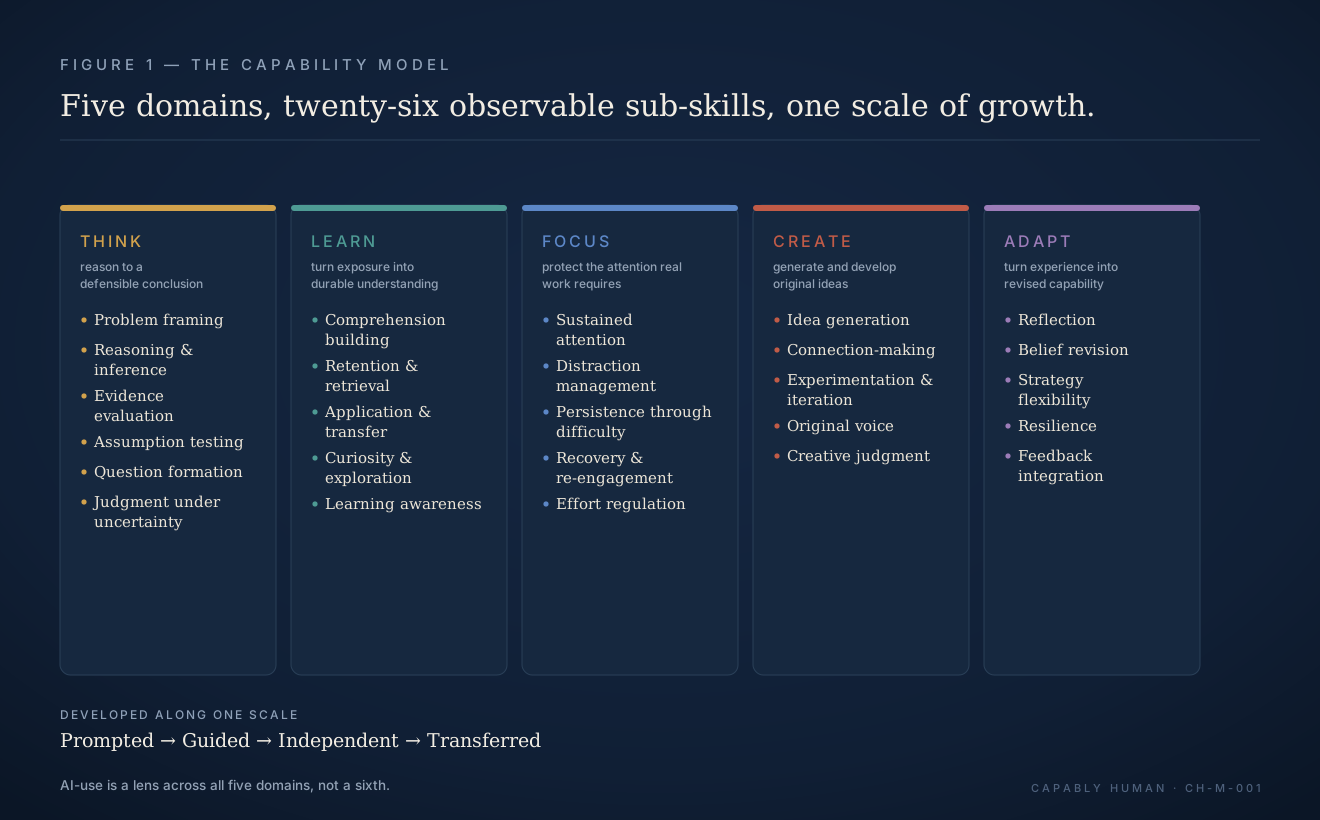
Every sub-skill also names its AI failure mode: the particular way that delegating it too early can substitute for the practice that builds it. A few skills matter more because of AI, not less. Question Formation leads that list, since what AI returns depends on the question it is asked.
“The question is not whether to use AI. It is how,” Lapico said. “The Capability Model breaks capability into twenty-six things you can watch a person do, so we can test which ways of working with AI build each one and which replace it.”
Putting the framework to work
To put the framework into practice, Capably Human has published rules of engagement for working with AI. They cover the three decisions in any human-AI interaction: what to delegate and what to retain, when to trust the AI’s output and when to challenge it, and when to let it run and when to step in. Each choice is tested by the framework’s distinction between support and substitution.
The rules are published three ways, all free: The Rules of Engagement Check (CH-I-001), a one-page instrument anyone can run on a task before handing it to AI; The Rules of Engagement Model (CH-M-002); and The Rules of Engagement Guide (CH-G-002), with worked examples at work, at school and in later life.
The image the company uses for the role it wants AI to play is the spotter. In the gym, a spotter makes it possible to lift more than you could safely lift alone, watches while you do the work, and steps in only at the moment you need it, but never lifts the bar for you.
Why it matters
AI has become part of ordinary work quickly. The release cites Gallup’s finding that 53% of U.S. employees now use AI at work, and notes that most AI use today is shaped for output: faster answers, finished work, less effort. In a 2026 IBM Institute for Business Value survey, 60% of employees said they worry about their skills eroding, with critical thinking the skill they most often said was slipping.
The first randomized studies suggest the design of the help matters. In a Turkish high school, students who worked through math problems with a standard AI chatbot did 48% better on practice problems and 17% worse on a later exam taken without it, while a version designed to give hints rather than answers did about as well on the exam as practicing without AI. In three online experiments, published as a 2026 preprint that has not yet been peer-reviewed, about ten minutes of AI help left people solving 57% of later problems unassisted, against 73% for people who never had it. In both, the losses were concentrated where AI supplied answers rather than hints.
“Every generation has a responsibility to leave humanity more capable than it found it,” Lapico said. “AI is the most powerful tool we have ever built for that purpose, and the most efficient way we have ever found to avoid the effort that makes us capable in the first place. Which of those it becomes is a design decision, and it is being made right now.”
Published to be tested
Capably Human presents every publication as provisional. The framework states what evidence would count against it, and the model names its own leading gap: observable anchors for each proficiency level, which have not yet been written and tested. The company invites researchers, educators, product teams, employers, and policymakers to use, test, and critique the library.
It is also designing a trial program to test its claims directly, comparing ways of working with AI: AI drafting first versus the person attempting first, AI explaining versus AI asking questions, AI agreeing versus AI challenging, and full delegation versus structured hand-offs. Each trial will measure performance, learning, judgment, and independence. The designs will be published before the trials run, the trials will run with consenting alpha members of the company’s first product, and the results will be published as Capably Human Reports.
A book is coming soon (December 2026), and the waitlist for the Humably alpha is open now, with the alpha starting in Q1 2027.
Learn more
Cite this story
Capably Human Inc. (2026). Capably Human Launches with The Capability Fitness Framework. capablyhuman.com/news/capably-human-launches
© 2026 Capably Human Inc. All rights reserved. Media may quote and excerpt freely.