 Humably

Framework
The Capability Fitness Framework
Defining a New Framework for Human Capability in the Age of Artificial Intelligence
CH-F-001 v2.1 · Published July 3, 2026 · Updated October 23, 2026
Michael D. Lapico · Capably Human · 40 min read
Download the PDF and unlock the full library: free with your email.
Get the PDFPublication Details
- ID
- CH-F-001
- Version
- v2.1
- Type
- Framework
- Published by
- Capably Human
- Author
- Michael D. Lapico
- First published
- July 3, 2026
- Last updated
- October 23, 2026
- Reading time
- 40 min read
- Formerly titled
- The Mental Fitness Framework
- Formats
- Web · PDF
Cite this publication
Capably Human Inc. (2026). The Capability Fitness Framework (CH-F-001, v2.1). capablyhuman.com/CH-F-001
© 2026 Capably Human Inc. Licensed under Creative Commons Attribution-NonCommercial-NoDerivatives 4.0 International (CC BY-NC-ND 4.0). You may share unchanged copies for non-commercial purposes, with the full citation above. Commercial use, including paid workshops, training, coaching or consulting, and use in paid products, courses, software, or AI products and datasets, requires a licence from Capably Human Inc.
Short link capablyhuman.com/CH-F-001
Capability Fitness is the lifelong development and maintenance of human capability: the capabilities of the mind that people use to reason and decide, learn, focus, create, and adapt. This publication proposes a framework for studying and strengthening it.
Artificial intelligence makes this work urgent because it changes what people are asked to do for themselves, and repeated practice is how capability is built. The question AI raises is not whether it should help people. It is whether a given pattern of help is support, which leaves the meaningful work with the person, or substitution, which removes the practice through which capability develops.
Working Definition
Capability Fitness is the lifelong development and maintenance of the capabilities of the mind that enable people to reason and decide, learn, focus, create, and adapt throughout life.
Contents
14 sections · 40 min read
- ·Executive Summary
- ·Purpose, Audience, and Scope
- 1.Why Capability Fitness Matters Now
- 2.Defining Capability Fitness
- 3.The Capability Model
- 4.Development across Life
- 5.AI, Practice, and Design
- 6.Measurement and Research
- 7.Implications and Next Steps
- 8.Glossary of Key Terms
- 9.Selected Research Foundations
- 10.Selected References
- ·Version History
- ·Citation and Licence
Overview
Executive Summary
Capability Fitness is the lifelong development and maintenance of human capability: the capabilities of the mind that people use to reason and decide, learn, focus, create, and adapt. This publication proposes a framework for studying and strengthening it.
Artificial intelligence makes this work urgent because it changes what people are asked to do for themselves, and repeated practice is how capability is built. The question AI raises is not whether it should help people. It is whether a given pattern of help is support, which leaves the meaningful work with the person, or substitution, which removes the practice through which capability develops.
Capability Fitness is not a mental health concept, a measure of intelligence, a substitute for education, or a productivity program. The framework is developmental: it is focused on how people build and maintain the capabilities of the mind across a lifetime, and on how AI is changing those processes.
The framework rests on five propositions:
-
Human capability develops through practice. What people repeatedly attend to, attempt, evaluate, and reflect on shapes what they become able to do.
-
Technology changes patterns of practice. A tool can support a person’s effort. It can also substitute for the effort that would have built the ability.
-
Capability Fitness is multidimensional. Five domains (Think, Learn, Focus, Create, and Adapt) operate as one connected system of observable capabilities, not as separate traits.
-
Development is lifelong and contextual. Capability changes with age and experience, and with the responsibilities, culture, and environment a person lives in.
-
Measurement should serve development. Any future assessment should give feedback and show growth, interpreted in context and in the open, with the person’s dignity intact. It should not rank or sort people.
The framework is provisional by design. Its purpose is to organize inquiry, connect research that is currently scattered across fields, support practical experimentation, and give researchers, educators, technologists, policymakers, and families a shared language for human development in the age of AI.
Central Question
How do we help people become, and stay, more capable in a world of increasingly capable machines?
Scope
Purpose, Audience, and Scope
The Capability Fitness Framework establishes a common foundation for studying and advancing human capability at a time when the environments in which people learn and work are increasingly shaped by intelligent technology.
Its primary audience is the people who will build the field, rather than consumers. It is intended for:
-
researchers and academics who can test, critique, and refine the framework;
-
educators and learning leaders concerned with how people learn and think in AI-enabled settings;
-
technologists and product designers whose systems shape patterns of attention, reasoning, and reliance;
-
policymakers and institutional leaders working in education, workforce development, AI governance, child development, and public-interest technology;
-
funders, advisors, and strategic partners evaluating the long-term case for research and practice in Capability Fitness.
The publication does not claim that Capability Fitness is an established scientific construct. It proposes a conceptual framework that draws on education and learning science, psychology and cognitive science, neuroscience, philosophy, human development, public policy, and artificial intelligence.
Future editions will revise its definitions, domains, measures, and applications as evidence develops. This edition aims to give that work a clear starting point. The full model, with all twenty-six sub-skills and their failure modes, is set out in the companion publication, The Capability Model (CH-M-001), and a book-length treatment for general readers is in preparation.
Section 1
Why Capability Fitness Matters Now
Human Capability as a Social Asset
Societies invest heavily in infrastructure, research, education, health, and institutions because these systems expand what people can accomplish together. Each of them depends on the same input: people who can learn, weigh evidence, make decisions, work with others, and adapt when circumstances force a change of plans.
The products of thought are easy to see. Bridges, companies, laws, and discoveries are visible; the capacities that designed them, and that keep them running and improving, are not. That invisibility is how those capacities come to be neglected.
The result is an imbalance. Societies have systematic ways of building knowledge, technology, organizations, and physical health. They have been far less deliberate about developing, across a whole life, the capabilities of the mind on which all of those depend.
Foundational Question
How can societies intentionally develop and sustain the capabilities people need to learn, reason, adapt, create, and exercise sound judgment throughout life?
Education and Capability
Education is how a society preserves and transmits what it knows. The Capability Fitness Framework is not an alternative to education; it addresses a neighboring question. Education asks what people should know and be able to demonstrate. The framework asks how people acquire, test, apply, and revise what they know.
The two often come apart. A person can hold a great deal of information and have no way to judge which of it is wrong. A person can perform a familiar task well and stall on an unfamiliar one, or do well when instructions are complete and struggle once the instructions run out and no single correct answer exists.
Knowledge and capability are closely related but not identical. Education can build capability, and often does. It rarely names that building as a lifelong objective.
From Information Scarcity to Information Abundance
For most of history, information was scarce. Books, teachers, and experts were hard to reach, and knowing things and being able to recall them carried real value.
Digital technology ended that scarcity. Search engines made retrieval nearly free, and people who expect information to remain available tend to remember where to find it rather than the information itself (Sparrow, Liu, & Wegner, 2011). AI systems now produce explanations, summaries, analyses, and plans on request.
The difficulty has moved from obtaining information to using it well. That means asking a precise question, judging whether a source deserves trust, and deciding when the evidence is incomplete. As answers become cheaper, judgment becomes more valuable.
The Historical Pattern
Physical fitness offers a useful precedent. For most of human history, physical effort was built into work and daily life. Industrialization and modern convenience removed much of that demand. Physical capability mattered as much as before, but ordinary life no longer developed it reliably.
Societies responded by making physical development deliberate. What the environment no longer demanded, people learned to demand of themselves, and a science of training and a culture of exercise grew up around that choice.
AI may create a comparable challenge for the mind. Much mental effort that was once unavoidable can now be handed to a system, a pattern known as cognitive offloading (Risko & Gilbert, 2016). The help is often valuable. It also changes what people practice, and practice is how capability is built. Figure 1 sets out the parallel.
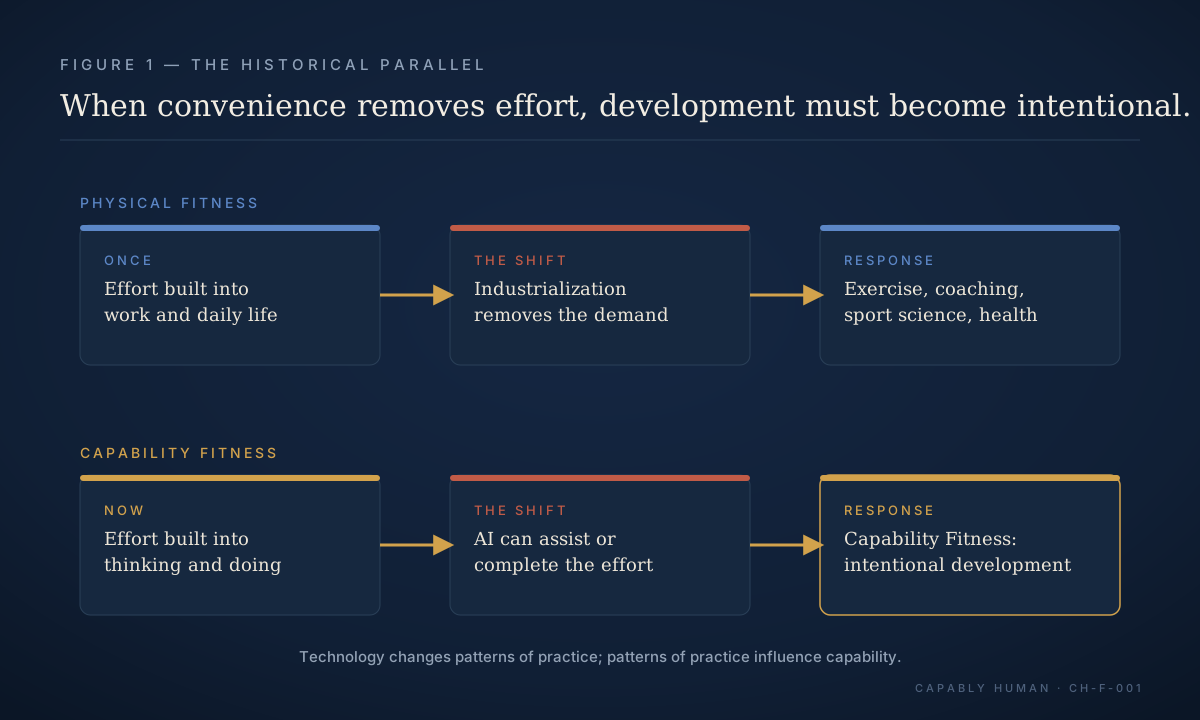
Figure 1. The historical parallel. When convenience removes the effort that daily life once supplied, development has to become intentional.
Core Principle
Technology changes patterns of practice. Patterns of practice influence capability.
Convenience and Capability
Whether to resist intelligent tools is the wrong question, and it has been the wrong question since the abacus. The useful question is when assistance supports a person’s capability and when it substitutes for the effort that would have developed it.
A calculator can perform a computation without building number sense. A search engine can retrieve a fact without teaching anyone which facts to trust. An AI system can produce an answer without improving the reasoning of the person who asked.
The effect depends on the task, the person, the setting, and the pattern of use. Earlier tools each took over one narrow job, while current AI systems can take part in nearly every stage of a task, from framing the problem to judging the result. The Capability Fitness Framework examines what that means for the people who use them.
Section 2
Defining Capability Fitness
A Working Definition
Definition
Capability Fitness is the lifelong development and maintenance of the capabilities of the mind that enable people to reason and decide, learn, focus, create, and adapt throughout life.
The definition emphasizes development and maintenance rather than classification. Capability Fitness is not a fixed trait or a permanent achievement; it changes with experience, practice, challenge, feedback, and environment. Much like physical fitness, it has to be maintained; what is built can be lost through disuse.
The comparison with physical fitness is useful, but limited. Physical fitness names several capacities, such as strength, endurance, and flexibility, that are developed and kept up over time. Capability Fitness is proposed in the same sense: as a way of understanding several capabilities of the mind and how they work together. But the limits of the analogy matter. Physical capacities are comparatively easy to measure. Their components are well characterized, and training gains carry reliably into daily activity. Capabilities of the mind are harder to observe and more tied to particular subjects or settings; gains on a practiced task do not automatically carry over to new ones. The analogy points toward deliberate, lifelong development and maintenance. It does not claim that the mind can be trained the way muscles can.
For the same reason, the framework does not propose to raise general cognitive capacity, and it is not a training program for intelligence or memory in the abstract. Its targets are twenty-six specific, observable sub-skills introduced in Section 3 and defined in The Capability Model (CH-M-001). Its claim is that these can be developed and can transfer to the real situations in which they are needed. An intervention built on the framework should therefore be judged by whether the targeted sub-skill appears where it had not been practiced, rather than by movement on a general cognitive measure. Claims of the latter kind have not held up in the brain-training literature (Simons et al., 2016), and this framework does not make them.
What Capability Fitness Is Not
The term can be read in several ways, so its boundaries need stating.
Capability Fitness is not mental health treatment. Mental health concerns emotional, psychological, and social well-being, including prevention, diagnosis, and clinical care. Capability Fitness may interact with well-being, motivation, and confidence, but it is not therapy or diagnosis.
Capability Fitness is not intelligence. Intelligence research is the study of cognitive ability and how it differs between people. Capability Fitness concerns how capabilities are developed and applied across settings and over time.
Capability Fitness is not academic achievement. Grades, credentials, and test scores carry useful information. They say less about curiosity, adaptability, judgment, or reflection, and little about how a person performs in an unfamiliar situation.
Capability Fitness is not productivity optimization. Greater speed or output is not evidence of better judgment or deeper understanding. The aim is capability, not efficiency alone.
Capability Fitness is not a ranking of human worth. It should not be used to label people, sort them, or reduce anyone to a single score.
Capability Fitness is not brain training. Commercial cognitive-training products have claimed that narrow computerized exercises improve general cognition, but the evidence for that kind of transfer is weak (Simons et al., 2016). The framework promises no general enhancement through games or drills. It concerns real tasks in real settings, and it treats transfer as an open research question rather than an assumption.
Human Capability as the Outcome
Capability Fitness names the work of development and maintenance; human capability is what that work produces. Capability, in this sense, is what people are able to do in response to the demands of life.
Capability is more than possessing knowledge. It shows in how knowledge is used, including whether a person can make sound judgments when information is incomplete and adjust when conditions change. It also shows in what a person does with experience: whether they learn from it, and whether they recognize where their own understanding ends.
A student becomes more capable not only by knowing more but by getting better at learning what they do not yet know. A professional becomes more capable not only by performing an established task but by adapting when the task, or the field around it, changes.
A Note on Terminology
“Human capability” has an established meaning in development economics and political philosophy. In the Capability Approach of the economist Amartya Sen and the philosopher Martha Nussbaum, it refers to the substantive freedoms and opportunities people have to live lives they value. This framework uses the term in a narrower, developmental sense: it indicates the capabilities of the mind that people bring to learning, judgment, and action. The two usages are distinct, but complementary: opportunity shapes development and development expands what opportunity can offer. This publication does not claim the Capability Approach’s theoretical apparatus.
Capability Fitness is also distinct from “mental fitness” as that term is used by wellness and emotional self-management brands. This framework uses “Capability Fitness” strictly in the cognitive-developmental sense defined above. It does not refer to mindfulness, emotional regulation, or clinical well-being.
The Need for a Shared Framework
Many fields study parts of human capability. Education studies learning and instruction, and psychology and cognitive science study attention, memory, reasoning, and decision-making. Neuroscience studies their biological basis, philosophy addresses knowledge and judgment, and human development follows change across the lifespan.
These contributions are substantial, but they are organized around different questions, methods, and institutions, so closely related capabilities are often studied in isolation. Meanwhile, artificial intelligence is reshaping the capabilities these fields study.
The Capability Fitness Framework is proposed as an integrative lens. It does not replace these fields or claim authority over them. Rather, it connects what they know around a single developmental question.
Relation to Adjacent Frameworks
The Capability Fitness Framework is not the first attempt to map broad human capabilities. Twenty-first-century skills frameworks, the OECD Learning Compass 2030, and “durable skills” taxonomies identify overlapping competencies, and research on executive function, self-regulated learning, and learning to learn studies several of the same capacities.
It differs from them in three ways:
-
It covers the whole lifespan, whereas most competency models are organized around schooling or early careers.
-
It is developmental rather than descriptive: it asks how capabilities are built and maintained through practice, rather than which competencies a curriculum or employer should list.
-
It is explicitly concerned with how intelligent technology reshapes the practice through which capabilities develop. Earlier frameworks did not face this condition in its current form.
The framework should develop in dialogue with these traditions, borrowing their validated constructs and measures wherever they exist.
Shared Question
How do the capabilities of the mind develop together, and how can environments, practices, institutions, and technologies support that development?
Section 3
The Capability Model
Capability Fitness Is Multidimensional
No single ability adequately represents human capability. One person may reason well and still fail to revise a mistaken assumption. Others may generate many ideas but lack the judgment to choose among them, or be curious but unable to sustain attention, or be expert in a specific area but lost when familiar conditions change.
Because of this, Capability Fitness is better understood as a system of interacting capabilities than as a single trait or a checklist. This publication organizes it around five domains:
Think is reasoning and judgment: framing problems, weighing evidence, testing assumptions, asking useful questions, and deciding under uncertainty.
Learn is building understanding that lasts: retaining knowledge, applying it in new settings, staying curious, and monitoring one’s own learning (Flavell, 1979).
Focus is the capacity to direct and sustain attention, persist through difficulty, and regulate one’s own effort.
Create is generating ideas, connecting them across contexts, experimenting, and producing original work.
Adapt is turning experience into growth through reflection, changes of strategy, belief revision when evidence warrants, and recovery from setbacks.
Each domain is defined at two levels: as a broad capability, used to communicate what the domain covers, and as a set of specific observable sub-skills, for assessment and development. The twenty-six sub-skills, listed in Table 1, are defined in full in the companion publication, The Capability Model (CH-M-001). The boundaries are working boundaries, expected to move as evidence accumulates.
| Domain | Sub-skills |
|---|---|
| Think | T1 Problem Framing · T2 Reasoning & Inference · T3 Evidence Evaluation · T4 Assumption Identification & Testing · T5 Question Formation · T6 Judgment Under Uncertainty |
| Learn | L1 Comprehension Building · L2 Retention & Retrieval · L3 Application & Transfer · L4 Curiosity & Exploration · L5 Learning Awareness |
| Focus | F1 Sustained Attention · F2 Distraction Management · F3 Persistence Through Difficulty · F4 Recovery & Re-engagement · F5 Effort Regulation |
| Create | C1 Idea Generation · C2 Connection-Making · C3 Experimentation & Iteration · C4 Original Voice · C5 Creative Judgment |
| Adapt | A1 Reflection · A2 Belief Revision · A3 Strategy Flexibility · A4 Resilience · A5 Feedback Integration |
Table 1. The twenty-six sub-skills of the Capability Model, by domain. Names and codes follow The Capability Model (CH-M-001).
Each sub-skill also carries a named AI failure mode: the specific way that delegating a piece of thinking to a machine too early erodes it. Examples include adopting a framing supplied by the model instead of forming one, accepting an argument because it is fluent, and abandoning a difficulty because an answer is one keystroke away.
Taken together, the failure modes turn a general concern about AI and cognition into twenty-six observable patterns that can be watched for, designed against, and measured. For a few sub-skills, notably problem framing (T1), evidence evaluation (T3), and question formation (T5), AI also raises the demand, a property this framework calls AI-amplified demand: the quality of a model’s output depends on the quality of the question, and fluent output is harder to check than a person’s work.
Why These Five
The five domains were chosen against explicit criteria. Every domain and sub-skill must be:
-
observable in behavior;
-
developable through practice;
-
directly relevant to how people use intelligent technology;
-
expressible in plain language.
Observability is what the other rules build on: a capability that cannot be observed cannot credibly be developed or measured. Some capabilities are observed through their effects rather than directly. Reflection shows in a plan that changes after a setback, and curiosity in the questions a person asks before accepting an answer.
The model also reflects deliberate boundary decisions. Memory is not a separate domain, although it underlies several. The framework’s central concern is how capability develops as people increasingly turn to search engines and artificial intelligence to remember for them, a question raised in Section 1. Social and emotional capacities such as empathy and collaboration appear only in part; the framework treats them as essential neighbors rather than core domains. This is a boundary that future editions should revisit.
There is also no domain for artificial intelligence. Using AI well is not treated as a separate skill. Rather, it is what strength across the five domains looks like when a machine is involved, together with judgment about what to delegate and what to keep.
Earlier editions described thirteen capabilities in four functional groups. The five-domain model supersedes that structure.
The Five Domains in One View
Figure 2 brings the five domains, their sub-skills, and the proficiency scale together.
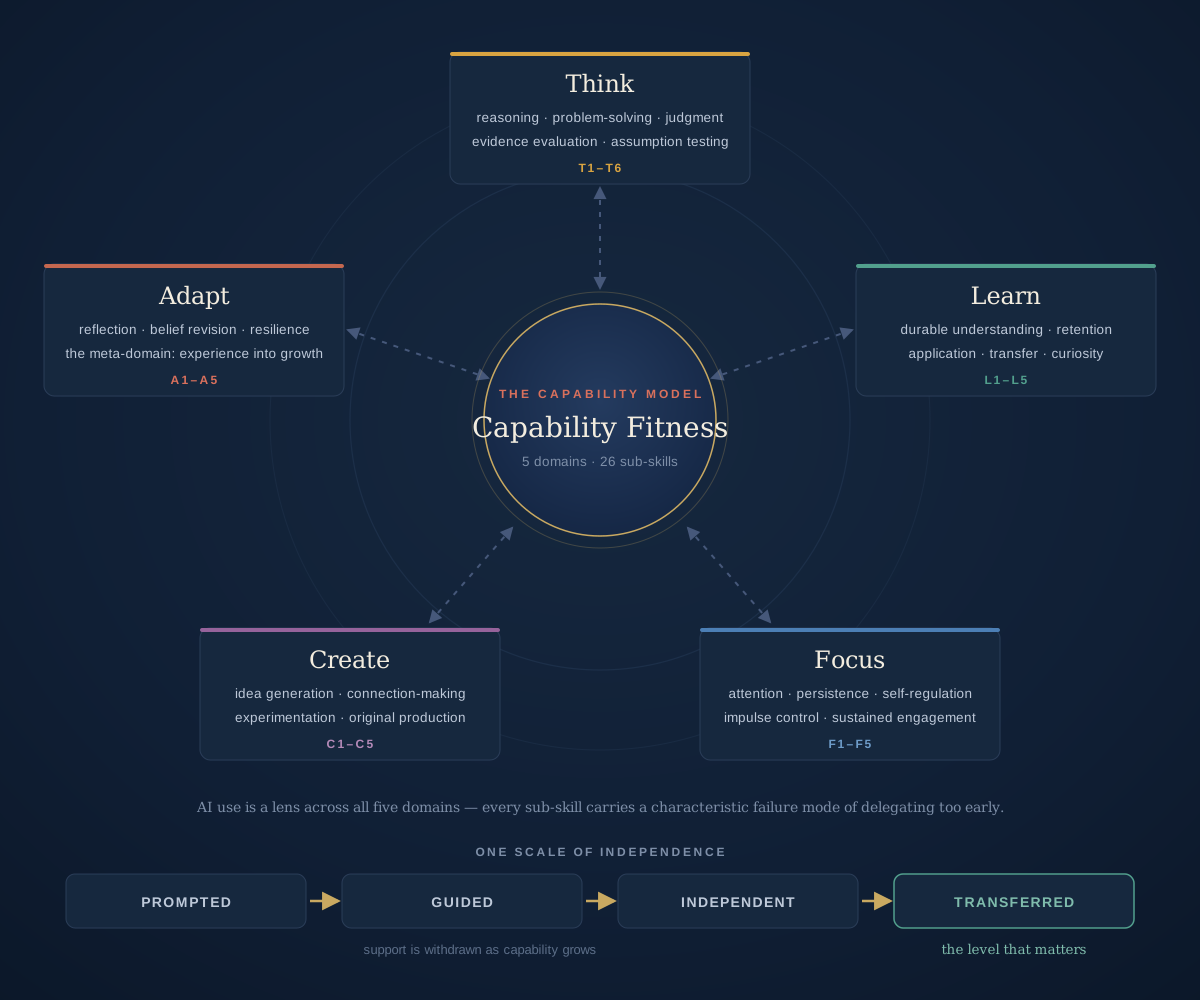
Figure 2. The Capability Model: five domains, twenty-six observable sub-skills, one scale of independence.
Proficiency: From Prompted to Transferred
Progress in any sub-skill is described on a single four-level scale of independence. At the Prompted level, the skill appears only when someone explicitly structures it. At Guided, it appears with light cues and is missed without them. At Independent, it appears unprompted within the setting where it was practiced. At Transferred, it operates outside that setting.
Transfer is the level that matters. Each of the first three can reflect familiarity with a setting rather than the capability itself; a student who reasons well in a seminar and never in a meeting has learned the seminar. The aim of development is movement toward transfer, with support withdrawn as capability grows.
The scale has a known gap. It does not yet specify, for each sub-skill, the behavioral anchors that would allow two observers to agree on a person’s level. Until those anchors are written and tested, the scale supports description but not reliable assessment. Developing them is a research priority.
Domains in Motion
In practice, the domains operate together. Faced with a difficult problem, a person uses Think to structure the reasoning, Learn to connect prior knowledge to new information, Focus to stay engaged through difficulty, Create to generate alternatives, and Adapt to turn the outcome, whether success or failure, into better performance next time.
Adapt is the meta-domain: it governs whether experience becomes growth. Reflection, in particular, comes before improvement in every other domain: without examining what happened and why, practice accumulates as repetition rather than development. Reflection is also the step that AI most easily removes, because finished output leaves no struggle to review.
The relative contribution of each domain varies by task and setting, and the weakest necessary sub-skill often sets the limit. The framework does not imply that everyone should develop the same profile, or that one ideal pattern applies across cultures, ages, roles, and circumstances.
Domains, Not Fixed Traits
The domains are areas of development, not permanent personal characteristics. Focus can be supported or fragmented by the environment, and reasoning improves with practice. Judgment matures with experience, reflection can become habitual, and curiosity can be encouraged or suppressed.
The purpose of naming domains is not to categorize people. It is to make capability development observable, discussable, and researchable.
Section 4
Development across Life
A Lifespan Framework
Formal education often presents learning as a sequence of stages that ends in a credential. Human development does not stop there. Careers change, relationships bring new responsibilities, technologies alter established practices, and aging changes what is asked of the mind. People keep meeting situations for which their education could not provide a script.
Those situations draw on the same capabilities in different proportions. A child learning to read, a physician making a clinical decision, an entrepreneur facing uncertainty, and an older adult learning a new technology each need some combination of learning, judgment, adaptation, and reflection, and each must act on incomplete information.
Scenario: the same tool, two directions
After a stroke, a retired teacher uses a speech-to-text tool to write to his family again, and the assistance restores a capability the injury took away. His granddaughter uses the same tool to skip the writing practice her coursework was meant to provide. For him, the tool is support. For her, it is substitution, and nothing in the finished text shows the difference.
Priorities Shift across the Lifespan
All five domains remain relevant throughout life, but the sub-skills under the most pressure, and most exposed to substitution by AI, shift with life stage. The mapping below is provisional: a set of hypotheses for research and program design, not a developmental sequence.
-
Childhood and adolescence. The formation years for Focus and Learn: sustained attention (F1), persistence through difficulty (F3), comprehension building (L1), and retention (L2). The risk is that effortful practice is bypassed before the capability has formed, so there is nothing to erode, only something that never develops.
-
Early and mid-career. The weight shifts to Think and Create: problem framing (T1), evidence evaluation (T3), question formation (T5), judgment under uncertainty (T6), and original work. These sub-skills are the most directly displaced when AI supplies conclusions, and the ones on which professional value increasingly rests.
-
Late career and older adulthood. Adapt and Learn come forward: belief revision (A2), strategy flexibility (A3), application and transfer (L3), and reflection (A1) that turns experience into judgment others can use. The risk runs in two directions: toward disuse of capabilities that work no longer demands, and toward assistance that substitutes for capability rather than restoring it.
Because environments differ so much within any stage, the mapping indicates where to look first, not what to prescribe.
Lifelong Learning Reconsidered
Lifelong learning is often defined as the continued acquisition of information or professional skill. The framework widens the question from what people continue to learn to how their capacity to learn and to judge is itself developing.
Reflection Questions
Are people becoming more capable of reasoning through complexity?
Are they better able to revise assumptions when evidence changes?
Are they more adaptable, reflective, and independent as learners?
Are they better able to make decisions under uncertainty without confusing confidence with understanding?
These questions are not answered once. They recur across education, work, family life, leadership, citizenship, and aging.
Section 5
AI, Practice, and Design
AI as an Environmental Shift
AI is not only a new category of tool. It changes the cognitive environment in which people learn and work.
Earlier technologies altered how people remember, navigate, communicate, and find information (Firth et al., 2019). Generative AI differs from them in three respects:
-
It is general. It can take part in almost any task that runs on language, numbers, images, or code.
-
It is fluent. It produces confident, finished-sounding output whether or not that output is correct, which makes the output harder rather than easier to judge.
-
It is instant. It closes the interval between not knowing and knowing in which much learning takes place.
These properties lower barriers, expand access, and increase productivity. They also change which parts of a task people perform themselves and which they hand to a system. The relevant unit of analysis is therefore the pattern of use that forms among a particular person, task, system, and setting, and not the tool alone.
Support versus Substitution
AI assistance is not inherently developmental or harmful. The framework distinguishes two patterns. Support is help that leaves the meaningful work with the person. Substitution is help that removes the effort through which capability is built. Which one a given use represents depends on what the person is trying to accomplish and whether unassisted capability matters in that setting.
The distinction rests on a two-part mechanism. Capability is built through effortful use: what people repeatedly attempt, evaluate, and correct is what they become able to do. Capability is lost through delegation: when an outside system reliably performs a mental function, people invest less in performing and retaining it themselves. The second is not a weakness but ordinary efficiency, which is why it is easy to miss.
For a person facing an accessibility barrier, assistance can be the difference between participating and not, and withholding it in the name of practice would be a mistake. Much routine work needs no practice at all. The risk lies in the cases in between: a student who receives an explanation and loses the reasoning it was meant to build, or a professional who accepts summaries and gradually stops checking what they assume.
Scenario: two kinds of help
A ninth-grader is stuck on an algebra problem at the kitchen table at nine at night. One AI tutor returns the finished solution; she copies it and moves on, and the homework is done. The other asks what she has tried, points at the step she missed, and asks her to explain why the fix works, which takes eleven more minutes and some grumbling. Both delivered an answer. Grade the homework and you cannot tell them apart. Hand her the next problem alone and you can.
The point of the distinction is not to preserve effort for its own sake. It is to recognize substitution in the settings where practice is needed for development, judgment, or accountability. Figure 3 sets out the distinction as a first-pass decision.
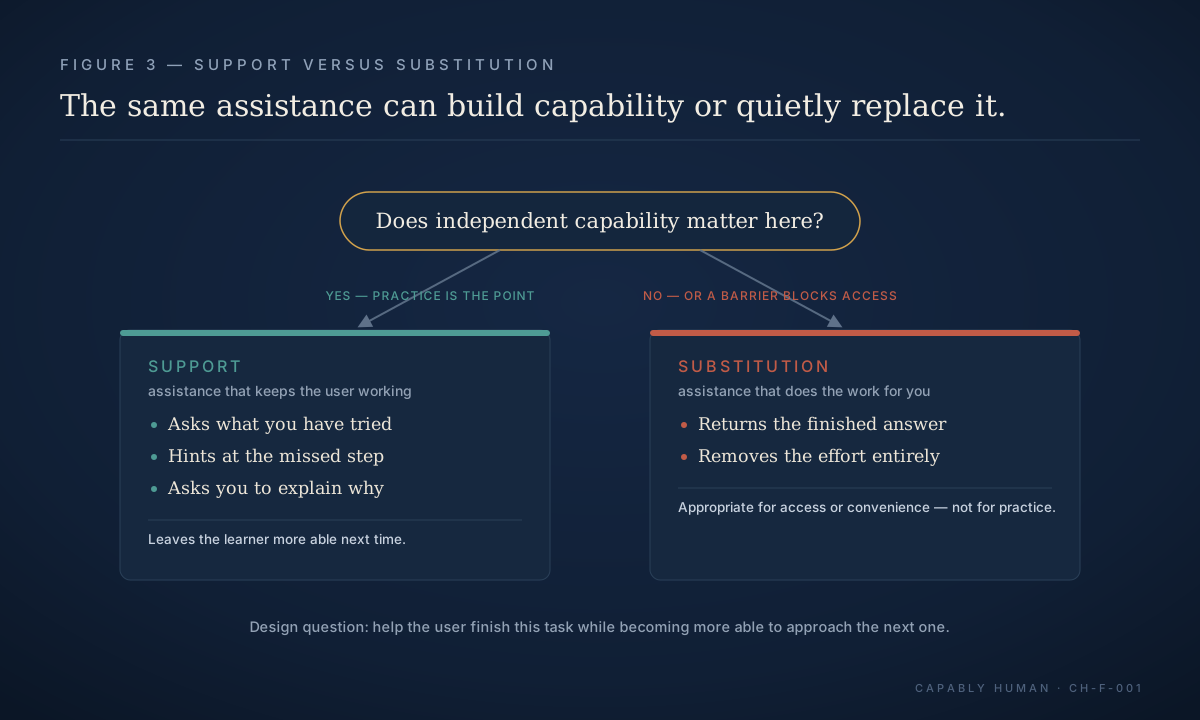
Figure 3. Support versus substitution: a first-pass design and usage decision.
Design Question
What kind of assistance helps the user complete the present task while becoming more capable of approaching the next one?
The Evidence So Far
Early evidence is consistent with the substitution mechanism, though it varies in strength. In a survey of 319 knowledge workers, greater confidence in generative AI was associated with less self-reported critical thinking about its output (Lee et al., 2025). In a sample of 666 adults, more frequent AI use correlated with lower critical-thinking scores, partly through cognitive offloading (Gerlich, 2025). A small, unreviewed preprint reported weaker neural engagement and poorer recall among students who wrote essays with a language model (Kosmyna et al., 2025), though its methods have been publicly questioned (Stanković et al., 2025). None of these studies can establish cause.
Two randomized studies can. In a Turkish high school, students who practiced mathematics with a standard GPT-4 interface scored 48 percent higher on practice problems than a textbook-only control group and 17 percent lower on a later exam taken without AI, while students given a version of the same model instructed to offer hints rather than answers performed about as well as the controls (Bastani et al., 2025). In three online experiments with about 1,060 analyzed participants, roughly ten minutes of AI assistance reduced later unassisted performance and persistence; in the first experiment, assisted participants solved 57 percent of subsequent problems against 73 percent for controls and skipped problems nearly twice as often (Liu et al., 2026). The decline was concentrated among participants who asked for direct answers rather than hints, although that comparison was not randomized.
The tasks were short and the exposures brief, so these studies establish a mechanism rather than its long-term reach. They nonetheless move the framework’s central claim from correlation toward cause: substituting assistance for effort can reduce persistence and unassisted performance, and the form the assistance takes matters.
Productive Challenge
Capability develops through engagement, feedback, repetition, and adjustment (Ericsson, Krampe, & Tesch-Römer, 1993). Learning science points the same way: effort that requires retrieval and struggle produces more durable learning than smooth, assisted completion (Roediger & Karpicke, 2006). This does not mean that more difficulty is always better.
Productive challenge stretches capability without overwhelming the learner. It preserves meaningful effort while providing enough structure, feedback, and support for progress. Poorly calibrated challenge produces confusion or disengagement rather than development.
This is what good coaching does. A coach adjusts support without removing the work that matters, and creates the conditions in which effort leads to learning.
Every Environment Reinforces Patterns of Mind
Capability develops within environments, and every environment rewards some patterns of mind over others. Families signal whether curiosity is welcome or an interruption, and schools whether learning feels like inquiry or performance. Workplaces determine whether judgment and constructive disagreement are rewarded, and communities shape how people meet difference, evidence, and uncertainty.
Technology reinforces patterns too. A platform optimized for immediate reaction shapes attention differently from one designed for reflection, and an AI tool that delivers finished answers encourages a different pattern of use from one that asks questions, offers staged hints, or supports revision.
Development is therefore not solely an individual responsibility. It depends on access and opportunity, on safety and support, and on the quality of the environments in which people live and learn.
Design as Practice-Shaping
A tool does more than complete a task. Through repeated use, it reinforces a way of approaching the task.
Interface choices, defaults, prompts, feedback, and timing influence what users do repeatedly. Repeated action becomes practice, practice becomes habit, and habit shapes capability over time. Product design is therefore also practice design, a loop shown in Figure 4.
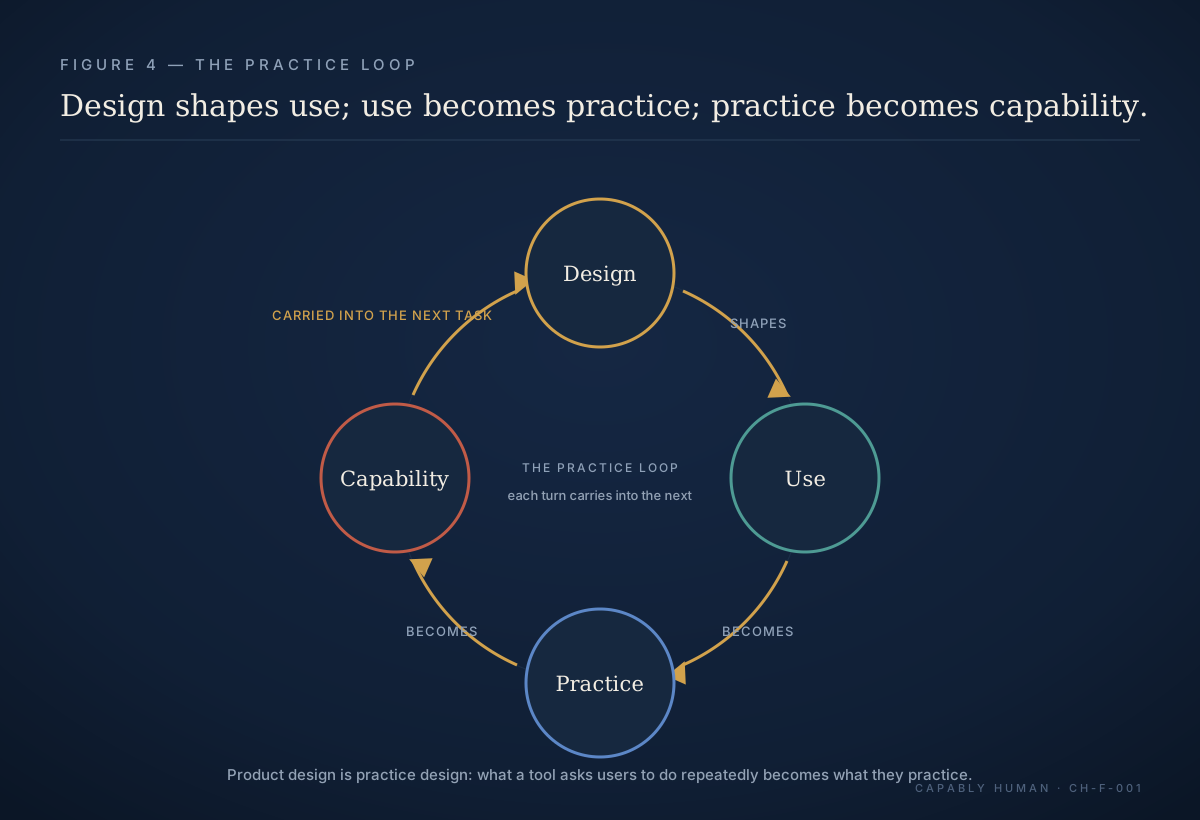
Figure 4. The practice loop. Design shapes use, use becomes practice, practice becomes capability, and the capability is carried into the next task.
Human-Strengthening AI
Human-Strengthening AI is proposed as a design orientation, not a product category. It asks whether an intelligent system leaves the user with more agency, understanding, and judgment, and with a greater capacity to act unassisted.
Eight principles define the orientation:
-
Attempt Before Assistance. The person thinks, responds, or tries before substantial help arrives.
-
Questions Before Answers. The system asks when a question will build more understanding than an immediate answer would.
-
Adaptive Friction. The effort that attention, learning, and real participation require is kept. Difficulty that serves nothing is removed.
-
Progressive Support. Assistance is fitted to the person and reduced as capability grows, moving them along the proficiency scale toward transfer.
-
Visible Uncertainty. What is established is kept distinct from what is interpretation, assumption, or guess.
-
Reflection After Action. The person is asked what they learned and what they would do differently.
-
Appropriate Delegation. The system helps the person decide what to hand to AI and what to keep as a human responsibility.
-
Capability Over Dependency. The system creates value without requiring permanent dependence on it. No longer needing the tool counts as success.
The objective is not to maximize effort in every interaction. It is to design assistance that fits the person, the task, the stakes, and the developmental purpose.
The principles describe how a system should behave. Capably Human is developing a companion set of rules of engagement for the person and the system together: what to delegate and what to retain, when to trust the system’s output and when to challenge it, and when to let it run and when to step in, each tested by support versus substitution. The rules are built on The Capability Model (CH-M-001) and are published as a check, a model and a guide (CH-I-001, CH-M-002, CH-G-002), and will be tested in trials, so that good outcomes and growing capability can be designed for together.
Section 6
Measurement and Research
Measurement in Service of Development
A framework concerned with development eventually needs ways to observe whether development is occurring, so research on Capability Fitness will need measurement. Measurement also carries the framework’s greatest risks.
Human capability is multidimensional, contextual, and changing. A single score would capture little of it and would invite inappropriate comparison and misplaced confidence in the number.
A more useful model is a dashboard rather than a report card: several indicators, viewed over time, that prompt questions about growth, context, and support without implying that one number represents the person. In practice, sub-skills are the level at which behavior can be observed, and domains are the level at which results are most usefully reported.
Measurement Guardrails
Any future measurement of Capability Fitness should observe eight guardrails:
-
Developmental: measurement should support learning, reflection, coaching, and improvement.
-
Multidimensional: no single indicator should be treated as a complete representation of capability.
-
Contextual: interpretation should account for age, culture, environment, motivation, opportunity, support, and task demands.
-
Humane: measures should avoid shame, unnecessary pressure, reductive labels, or claims about human worth.
-
Transparent: people should understand what is measured, why it is measured, and how results will be used.
-
Evidence-based: constructs and instruments should be supported by rigorous research rather than attractive terminology alone.
-
Equitable: design and use should examine differential access, bias, cultural assumptions, and unintended consequences.
-
Privacy-preserving: data collection should be proportionate, secure, and especially protective of children and learners.
The aim of measurement is feedback, not classification. Measures should help identify patterns, guide support, test interventions, and improve environments.
Measurement should also privilege transfer. Improvement in the setting where practice occurred is evidence of learning the setting until the skill appears where it was not practiced. A product that tracks only performance inside itself can show improvement while unassisted capability declines, as the practice scores in the classroom study in Section 5 illustrate (Bastani et al., 2025).
A Methodology Hierarchy
For research collaborators, the guardrails imply an ordering of methods. Behavioral evidence is preferred to self-report, because what a person does with a novel problem, unassisted, says more than what they report about their habits. Change within a person over time is preferred to comparisons between groups at one moment. Study designs can be ordered by the strength of the claim each supports: descriptive and correlational studies identify patterns, longitudinal tracking tests whether change follows use, randomized experiments establish cause, and transfer studies test whether a developed sub-skill appears outside the setting in which it was practiced. Each design answers a different question, and none of the earlier ones can stand in for the last. Most current evidence on AI and capability sits in the first two categories.
Research Status
The Capability Fitness Framework should be treated as a proposal, and Capability Fitness as a proposed construct rather than an established one. The framework’s usefulness must be tested through conceptual analysis, empirical study, intervention research, and practical application.
Its purpose is to organize questions that currently span several fields. It should not be treated as validated because it is intuitively appealing.
How This Framework Could Fail
A framework that invites critique should state what would count against it. This one would be undermined by evidence that:
-
its domains do not cohere as a system, or add nothing beyond established constructs;
-
interventions improve performance only on trained tasks, with no durable transfer;
-
measurement is reductive or harmful despite the guardrails; or
-
patterns of AI use have no meaningful effect on capability development.
Each outcome is possible. Treating them as live hypotheses rather than threats is what distinguishes a research framework from a slogan.
Priority Research Questions
Conceptual
Which capabilities should be included in the Capability Model? How should they be defined? Which are foundational, and how do they interact?
Developmental
How do these capabilities develop across childhood, adolescence, adulthood, and aging? How do culture, environment, opportunity, and major life transitions affect them?
Measurement
Which indicators can validly and reliably reflect development without reducing capability to simplistic scores? How should change be interpreted across contexts and over time?
Intervention
Which forms of teaching, coaching, practice, feedback, mentorship, and environmental design strengthen particular capabilities? Under what conditions do effects transfer beyond the original task?
Artificial Intelligence
How does regular AI use change attention, reasoning, memory, metacognition, creativity, judgment, and unassisted problem solving? Which interaction patterns support capability, and which encourage overreliance or reduced oversight?
Ethics and Society
Who benefits from Capability Fitness research and tools? Who bears risk? How should privacy, access, cultural difference, disability, power, and inequality shape the field?
The Role of Capably Human
Capably Human cannot answer these questions alone. Research on Capability Fitness is interdisciplinary by nature and should develop through collaboration among researchers, educators, practitioners, technologists, policymakers, communities, and people with lived experience.
Capably Human’s role is to help convene that work: proposing shared language, developing research agendas, running trials that compare ways of working with AI, supporting evidence-based practice, publishing findings as reports, inviting critique, and building partnerships.
Section 7
Implications and Next Steps
Education
The framework suggests that education should make capability development as explicit a goal as knowledge acquisition. This does not require abandoning curriculum, subject knowledge, assessment, or academic standards. It requires closer attention to how students learn, reason, explain, and reflect.
AI-supported learning should be judged both by whether students complete tasks or reach correct answers and by whether they build understanding and retain the ability to work unassisted. Assessments that include novel problems attempted without help are one practical way to check.
Technology and Product Design
Technology organizations should consider the developmental effects of repeated use. Engagement, completion, speed, and convenience do not indicate whether a system builds attention, judgment, learning, or agency. Measures of what users can do unassisted, some time after use, would.
Products should distinguish between settings in which automation is the right objective and settings in which development, oversight, or accountability requires continued human participation. Capably Human’s rules of engagement (Section 5) are offered as a practical starting point for drawing that line, feature by feature.
Workplaces and Institutions
Workplaces shape capability through task design, incentives, feedback, autonomy, and access to learning. AI adoption plans should consider both efficiency gains and the forms of expertise and judgment employees need to keep in active use, along with how they will continue to practice them. Routine entry-level work has long been where professional judgment is first developed, and if AI absorbs that work, organizations will need deliberate ways to rebuild the apprenticeship it provided.
Scenario: judgment in disuse
An analyst begins using AI to summarize market reports. For the first month he checks each summary against the source. By the sixth he does not, because none of them has ever been wrong, and nothing fails until the morning one is. The tool did not take away his judgment. Disuse did, one accepted summary at a time.
Institutions can foster Capability Fitness by making room for inquiry, reflection, constructive disagreement, cross-disciplinary learning, and responsible experimentation.
Policy and Public Interest
The framework raises public-interest questions in education, workforce development, technology governance, privacy, accessibility, and equity.
Policy should not treat capability development as solely an individual obligation. Opportunity, health, safety, economic conditions, educational quality, social support, and access to technology all influence it. If assistance designed to build capability becomes a premium product while assistance that substitutes for it is free, existing inequalities could widen in ways that are hard to see.
A responsible framework should expand opportunity rather than become a new mechanism for ranking, exclusion, or pressure.
A Field-Building Agenda
The immediate task is not to declare the field of Capability Fitness complete. It is to determine whether the framework helps researchers and practitioners ask better questions, connect evidence, design useful studies, and build more effective interventions.
Priority next steps include:
-
refine the working definition and the five-domain Capability Model;
-
develop a formal research map and literature review;
-
identify existing validated measures relevant to each domain and sub-skill;
-
write and test behavioral anchors for the proficiency scale;
-
design initial studies of AI use, cognitive practice, and capability development;
-
develop and test the Human-Strengthening AI principles;
-
establish ethical, privacy, and equity standards;
-
convene interdisciplinary advisors, researchers, educators, technologists, and public-interest partners;
-
publish revisions as evidence and critique accumulate.
What Readers Can Do
Researchers can test the domain model against existing constructs, critique its definitions, and pursue the questions in Section 6. Educators and learning leaders can examine where AI use in their settings is support and where it is substitution, and share what they observe. Technologists and designers can prototype and evaluate the Human-Strengthening AI principles in Section 5 and publish what works and what fails. Policymakers and institutional leaders can weigh capability development alongside access and efficiency in AI adoption and education decisions. Funders and partners can support the agenda above, particularly measurement validation and intervention studies. Critique of this publication is welcome and can be directed to Capably Human.
Closing Question
How can increasingly capable technologies be designed and used in ways that expand, rather than diminish, human capability?
The Capability Fitness Framework is offered as a starting point for that work. Its value will depend on whether it can be tested, corrected, and applied in ways that leave people more capable in education, work, technology, and public life.
Section 8
Glossary of Key Terms
Human Capability
What people are able to do in response to the demands of life; the outcome of Capability Fitness (see Section 2). Distinct from the constituent capacities themselves (see Capabilities of the Mind) and from the Capability Approach of Sen and Nussbaum.
Capability Fitness
The lifelong development and maintenance of the capabilities of the mind that enable people to reason and decide, learn, focus, create, and adapt throughout life.
Capabilities of the Mind
The cognitive, reflective, adaptive, creative, communicative, and judgment-based capacities through which people understand the world and act within it.
The Capability Model
The working model that organizes Capability Fitness into five domains (Think, Learn, Focus, Create, and Adapt) and twenty-six observable sub-skills, each developed along a four-level scale of independence. Defined in full in The Capability Model (CH-M-001).
Proficiency Scale
The four levels of independence on which progress in any sub-skill is described: Prompted → Guided → Independent → Transferred.
Transfer
A capability operating outside the setting in which it was practiced; the highest level of the proficiency scale and the standard by which development is judged.
AI Failure Mode
The characteristic way in which delegating a specific piece of thinking to AI too early erodes the capability beneath it. Every sub-skill in the Capability Model carries one.
AI-Amplified Demand
The property of a sub-skill whose importance AI raises as well as threatens, such as problem framing, evidence evaluation, and question formation.
Practice
Repeated, effortful use of a capability, in which a person attempts, evaluates, and corrects their own work; the means by which capability is built and maintained. Support leaves practice with the person; substitution removes it.
Support and Substitution
Support is help that leaves the meaningful work with the person. Substitution is help that removes the effort through which capability is built.
Cognitive Offloading
The use of tools, technologies, or external systems to reduce the cognitive effort required to perform a task.
Productive Challenge
A level of difficulty that stretches capability without overwhelming the learner, especially when paired with feedback, support, reflection, and meaningful practice.
Human-Strengthening AI
Artificial intelligence designed and used to strengthen human capability, agency, understanding, and judgment rather than to substitute for them; defined by eight principles (see Section 5).
Practice Design
The intentional design of tools, environments, and experiences that shape what people repeatedly do and, over time, what they become capable of doing.
Section 9
Selected Research Foundations
The Capability Fitness Framework is integrative. Its development should draw on established areas of research rather than treat the framework as a stand-alone body of knowledge.
Learning Science
Relevant areas include retrieval practice, the testing effect, spacing, interleaving, desirable difficulties, deliberate practice, feedback, formative assessment, and transfer of learning.
Cognitive Science and Psychology
Relevant areas include attention, memory, metacognition, self-regulated learning, cognitive load, reasoning, creativity, motivation, self-efficacy, expertise, judgment, and decision-making.
Technology and Cognitive Offloading
Relevant areas include cognitive offloading, transactive memory, internet search behavior, digital attention, human-computer interaction, tool-mediated cognition, automation bias, and reliance on decision-support systems.
Artificial Intelligence and Education
Relevant areas include human-centered AI, AI literacy, pedagogical design, intelligent tutoring, learning analytics, student privacy, bias and fairness, human oversight, and responsible AI use.
Human Development and Lifelong Learning
Relevant areas include developmental psychology, adolescence, adult learning, identity formation, leadership development, lifelong learning, cognitive aging, and social learning.
Ethics, Equity, and Public Policy
Relevant areas include educational equity, assessment ethics, privacy and data governance, child safety, accessibility, cultural responsiveness, labor and workforce transitions, and public-interest technology.
Section 10
Selected References
The references in this edition are orientation points, not a complete review of the literature. Future editions should develop a formal bibliography and research map.
Learning Science and Psychology
Bandura, A. (1997). Self-Efficacy: The Exercise of Control. W. H. Freeman.
Bjork, R. A., & Bjork, E. L. Research on desirable difficulties, retrieval practice, spacing, interleaving, and memory. Bjork Learning and Forgetting Lab, UCLA.
https://bjorklab.psych.ucla.edu/research/
Ericsson, K. A., Krampe, R. T., & Tesch-Römer, C. (1993). “The Role of Deliberate Practice in the Acquisition of Expert Performance.” Psychological Review, 100(3), 363–406.
Flavell, J. H. (1979). “Metacognition and Cognitive Monitoring: A New Area of Cognitive-Developmental Inquiry.” American Psychologist, 34(10), 906–911.
Roediger, H. L., III, & Karpicke, J. D. (2006). “Test-Enhanced Learning: Taking Memory Tests Improves Long-Term Retention.” Psychological Science, 17(3), 249–255.
Simons, D. J., Boot, W. R., Charness, N., Gathercole, S. E., Chabris, C. F., Hambrick, D. Z., & Stine-Morrow, E. A. L. (2016). “Do ‘Brain-Training’ Programs Work?” Psychological Science in the Public Interest, 17(3), 103–186.
Technology and Cognition
Firth, J., et al. (2019). “The Online Brain: How the Internet May Be Changing Our Cognition.” World Psychiatry, 18(2), 119–129.
Risko, E. F., & Gilbert, S. J. (2016). “Cognitive Offloading.” Trends in Cognitive Sciences, 20(9), 676–688.
Sparrow, B., Liu, J., & Wegner, D. M. (2011). “Google Effects on Memory: Cognitive Consequences of Having Information at Our Fingertips.” Science, 333(6043), 776–778.
AI Use and Cognition
Bastani, H., Bastani, O., Sungu, A., Ge, H., Kabakcı, Ö., & Mariman, R. (2025). “Generative AI Without Guardrails Can Harm Learning: Evidence from High School Mathematics.” Proceedings of the National Academy of Sciences, 122(26), e2422633122.
Gerlich, M. (2025). “AI Tools in Society: Impacts on Cognitive Offloading and the Future of Critical Thinking.” Societies, 15(1), 6. Corrected in Societies, 15(9), 252 (September 2025): a duplicated table was replaced; the author states the conclusions are unaffected, and the claim cited here is unchanged.
Kosmyna, N., Hauptmann, E., Yuan, Y. T., Situ, J., Liao, X.-H., Beresnitzky, A. V., Braunstein, I., & Maes, P. (2025). “Your Brain on ChatGPT: Accumulation of Cognitive Debt when Using an AI Assistant for Essay Writing Task.” arXiv:2506.08872. Methodological note: an unreviewed preprint with a small sample (N = 54; 18 in the crossover session) whose EEG methodology is under active comment (Stanković et al., 2025). Cited here as motivation only; the headline figures that circulated in press coverage of this study are not cited.
Lee, H.-P., Sarkar, A., Tankelevitch, L., Drosos, I., Rintel, S., Banks, R., & Wilson, N. (2025). “The Impact of Generative AI on Critical Thinking: Self-Reported Reductions in Cognitive Effort and Confidence Effects From a Survey of Knowledge Workers.” In Proceedings of the 2025 CHI Conference on Human Factors in Computing Systems (CHI ’25).
https://doi.org/10.1145/3706598.3713778
Liu, G., Christian, B., Dumbalska, T., Bakker, M. A., & Dubey, R. (2026). “AI Assistance Reduces Persistence and Hurts Independent Performance.” arXiv:2604.04721. Three randomized controlled trials; 1,222 participants recruited and about 1,060 analyzed.
Stanković, M., Hirche, E., Kollatzsch, S., & Doetsch, J. N. (2025). “Comment on: Your Brain on ChatGPT: Accumulation of Cognitive Debt When Using an AI Assistant for Essay Writing Tasks.” arXiv:2601.00856.
Artificial Intelligence and Education
OECD. (2023). OECD Digital Education Outlook 2023: Towards an Effective Digital Education Ecosystem. OECD Publishing.
https://doi.org/10.1787/c74f03de-en
Sharples, M. (2023). “Towards Social Generative AI for Education: Theory, Practices and Ethics.” arXiv:2306.10063.
UNESCO. (2023). Guidance for Generative AI in Education and Research.
https://unesdoc.unesco.org/ark:/48223/pf0000386693
U.S. Department of Education, Office of Educational Technology. (2023). Artificial Intelligence and the Future of Teaching and Learning: Insights and Recommendations.
https://www.ed.gov/sites/ed/files/documents/ai-report/ai-report.pdf
Human Development and the Capability Approach
Nussbaum, M. C. (2011). Creating Capabilities: The Human Development Approach. Harvard University Press.
OECD. (2019). OECD Future of Education and Skills 2030: OECD Learning Compass 2030. OECD Publishing.
Sen, A. (1999). Development as Freedom. Alfred A. Knopf.
Physical Activity and Public Health
World Health Organization. (2020). WHO Guidelines on Physical Activity and Sedentary Behaviour.
History
Version History
2.1 — October 23, 2026. Additions only, following Capably Human’s positioning work (Capable Together). Section 5 adds a paragraph introducing the rules of engagement as the companion to the Human-Strengthening AI principles; Section 7 (Technology and Product Design) points to them; Section 6 (The Role of Capably Human) adds trials and reports. The Central Question and all other content are unchanged. Version 2.0 is archived under Previous Versions.
2.0 — October 22, 2026. Revised after an editorial review of the Executive Summary and Sections 2 and 3, with a line edit of the remaining sections. The definition of Capability Fitness now follows the five domains (reason and decide, learn, focus, create, and adapt), and the Central Question reads “become, and stay, more capable.” “Capability Fitness” is used only for the construct the framework defines; the publication is “the Capability Fitness Framework” or “the framework.” The TL;DR was folded into the Executive Summary. Section 3 adds a table of the twenty-six sub-skills (Table 1), lists the four design rules, and notes that some capabilities are observed through their effects. Section 4 merges its two opening subsections, and its discussion of environments moves to Section 5. Terminology was made consistent throughout (support and substitution; Human-Strengthening AI; guardrails for measurement and principles for design; unassisted for performance without AI; domain reserved for the five domains). Figures are cited in the text, “Vignette” callouts are now “Scenario,” Sen and Nussbaum are identified, the memory cross-reference points to Section 1, headings follow headline capitalization, and a glossary entry for practice was added. No change to the domains, sub-skills, proficiency scale, principles, guardrails, evidence, or references.
Terminology update — October 14, 2026. “Mental Fitness” renamed “Capability Fitness” throughout, including the publication title, following an advisory board review. No other changes to content, structure, or claims.
1.9 — October 9, 2026. Rebased on the structure and length of version 1.5, after review found that versions 1.7 and 1.8 had more than doubled the publication’s length and moved it toward a book-length narrative. Retained from later versions: the statement that the framework targets specific sub-skills and transfer rather than general cognitive capacity; AI failure modes and AI-amplified demand; the behavioral-anchors gap in the proficiency scale; the priority of reflection; the provisional life-stage mapping; explicit definitions of support and substitution and the mechanism behind them; the evidence on AI use with methodological caveats and both randomized studies (Bastani et al., 2025; Liu et al., 2026, with corrected figures); and the methodology hierarchy. Prose revised for clarity in an academic register. The historical and case material added in 1.8 was removed and is left to the book-length treatment.
1.8 — October 9, 2026. Content revision drawing on the manuscript of Heavy Lifting (the book-length treatment of the framework). Added the historical anchor for the embedded-effort argument (Morris et al., 1953; Kraus & Hirschland, 1954; Lieberman, 2020) and the four-stage pattern with its lag; the trade-off record for earlier thinking tools (Plato; Henkel, 2014; Ellington, 2003; Woollett & Maguire, 2011; Dahmani & Bohbot, 2020); the brain-training and transfer history (FTC, 2016; Thorndike & Woodworth, 1901; Gick & Holyoak, 1980); per-domain AI exposure, the AI-amplified demand on three sub-skills, the overlap caveat, and the behavioral-anchors gap in Section 3; the structural priority of reflection; stage-specific evidence in Section 4 (Pauly, 1995; Bastani et al., 2025; Bainbridge, 1983; Budzyń et al., 2025; Brynjolfsson et al., 2026; Rohwedder & Willis, 2010; Stern, 2002); the general-fluent-instant account of AI, explicit definitions of support and substitution, and the two-part mechanism in Section 5; added Bastani et al. (2025) as the second randomized study and corrected the Liu et al. (2026) figures (recruited vs. analyzed; three effect sizes); the provenance of the eight principles (Sinha & Kapur, 2021; Kestin et al., 2025; Wood, Bruner, & Ross, 1976; Murphy & Winkler, 1977); measurement history and Campbell’s law in Section 6; workplace, policy, and two-futures material in Section 7; six glossary entries; and thirty-odd references. Definition, domains, sub-skills, scale, principles, guardrails, figures, and callouts are unchanged.
1.7 — October 9, 2026. Writing pass to the Capably Human writing voice (Profile v1.0): prose rewritten throughout for flow and voice, with list-shaped sentences unpacked, dashes removed, repetition cut, and scenes and reversals staged where the argument turns. Every finding, citation, figure, callout, and definition is preserved; no change to content, structure, or claims.
1.6 — September 24, 2026. Evidence and scope revision following the July 2026 analysis and review. Added the first randomized evidence for the substitution mechanism (Liu et al., 2026) to Section 5 and the references; flagged Kosmyna et al. (2025) as an unreviewed preprint under methodological comment and added Stanković et al. (2025); noted the Gerlich (2025) correction. Added a statement in Section 2 that the framework targets specific sub-skill transfer rather than general cognitive capacity; foregrounded the AI failure mode apparatus in Section 3; added a provisional life-stage mapping of priority sub-skills in Section 4 and a methodology hierarchy in Section 6.
1.5 — July 20, 2026. Aligned with the Capability Fitness Platform document set and The Capability Model (CH-M-001): replaced the thirteen-capability, four-group structure with the five-domain Capability Model (Think, Learn, Focus, Create, Adapt) and its twenty-six sub-skills; adopted the Prompted → Guided → Independent → Transferred proficiency scale and transfer-first measurement; replaced the design-principle list with the eight Human-Strengthening AI Principles; added a naming note and Gerlich (2025); redrew Figure 2.
1.4 — July 17, 2026. Added boundaries with brain training and the transfer problem; a note on terminology and the Capability Approach; relation to adjacent frameworks; dimension selection criteria; a falsifiability discussion; audience-specific next steps; suggested citation and version history. Added Figures 1–4, three vignettes, inline citations, and 2025 evidence on AI use and cognition (Lee et al.; Kosmyna et al.). Unified the canonical capability list, clarified the limits of the physical-fitness analogy, and made line edits throughout.
1.3 — July 13, 2026. Prior working draft, preserved as a separate page.
Citation
Citation and Licence
Capably Human Inc. (2026). The Capability Fitness Framework (CH-F-001, v2.1). capablyhuman.com/CH-F-001
© 2026 Capably Human Inc. Licensed under Creative Commons Attribution-NonCommercial-NoDerivatives 4.0 International (CC BY-NC-ND 4.0). You may share unchanged copies for non-commercial purposes, with the full citation above. Commercial use, including paid workshops, training, coaching or consulting, and use in paid products, courses, software, or AI products and datasets, requires a licence from Capably Human Inc.
Download the PDF and unlock the full library
Free with your email. Leave it once and the whole library opens in this browser: the PDF edition of this publication, and the full text of every other one, now and as new work is published.
- The PDF edition of The Capability Fitness Framework
- The full text of every other framework, model, report, guide and instrument in the library
- Printable PDF editions where they exist
Also in the Library
Back to the library