 Humably

In March 2025, around nine at night, I was at my desk in my home office in Windsor, working through a complicated UX problem for a building management platform. Figma was open on one monitor, the requirements and my notes on the other. It was the kind of problem I'd spent nearly thirty years solving, and normally I'd start by sketching out a few ideas.
Instead, almost without thinking, I opened ChatGPT. I pasted in the requirements and asked for three possible approaches, and within seconds I had user flows, recommendations, and some surprisingly good ideas.
Then I looked down. My notebook was sitting beside the keyboard, still blank. I hadn't even tried to solve the problem myself.
Maybe you know the feeling. The small, sweet relief of watching a blank page fill itself. The hours you get back. And underneath it, if you're paying attention, something else. Not guilt, exactly. More like taking the elevator every day and noticing, one morning, that the stairs have gotten harder.
For a while, I had a good answer for that feeling. I could tell when the work was good. Thirty years of building digital products gives you an eye. I could look at what the machine handed back and see, in seconds, what was right, what was wrong, and what was quietly missing. The AI did the lifting. I did the judging. It seemed like a fair deal.
That night, the deal looked different. I wasn't worried about AI replacing me. I was worried about becoming so dependent on it that I'd stop exercising the skills I'd spent my career developing. And sitting there next to a blank notebook, a question showed up that I couldn't put down: where did that eye come from?
To answer it, I have to go back to 1986.
A blinking cursor
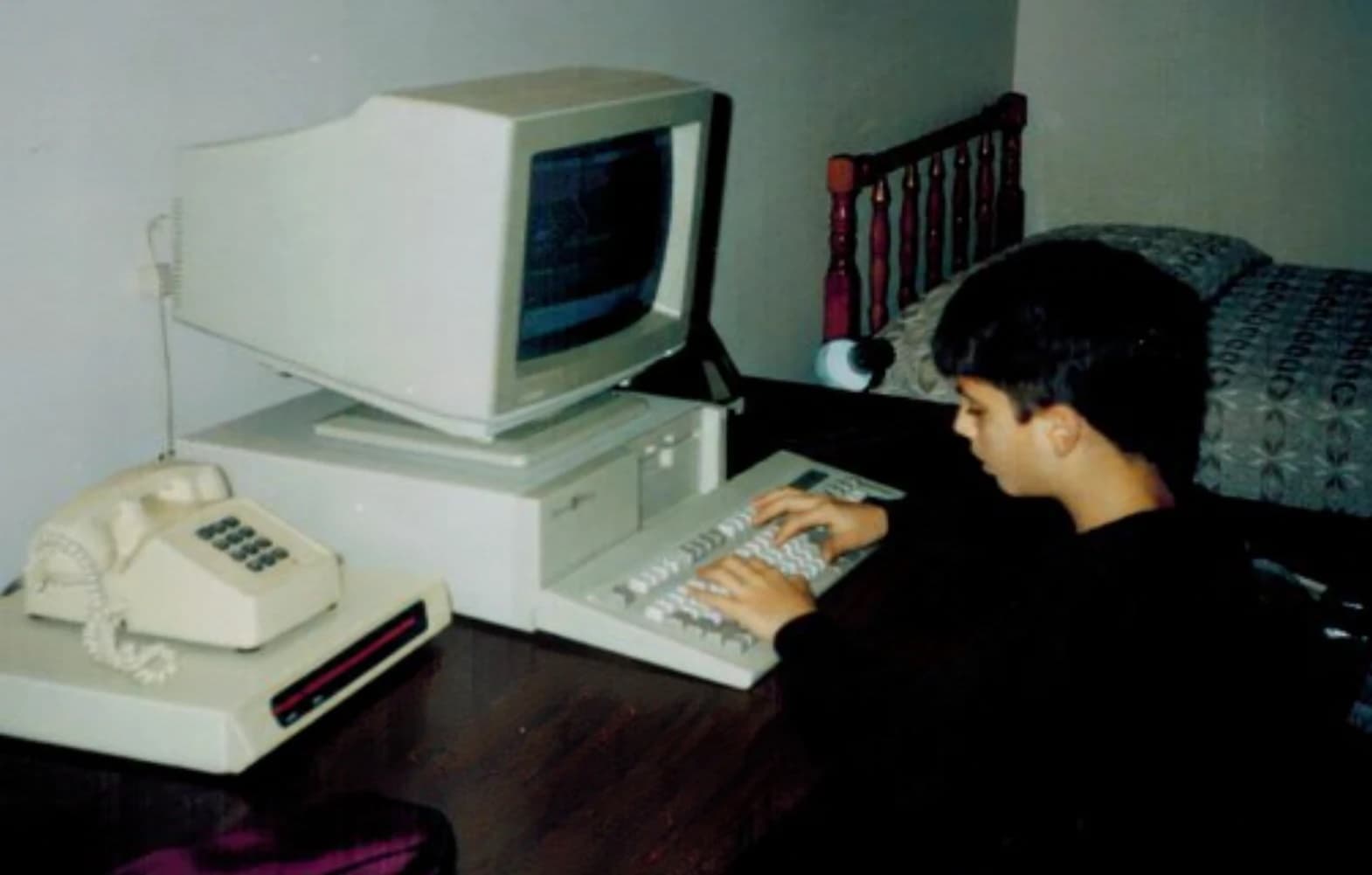
In the winter of 1986, my family brought home a 286 computer. I was seven years old.
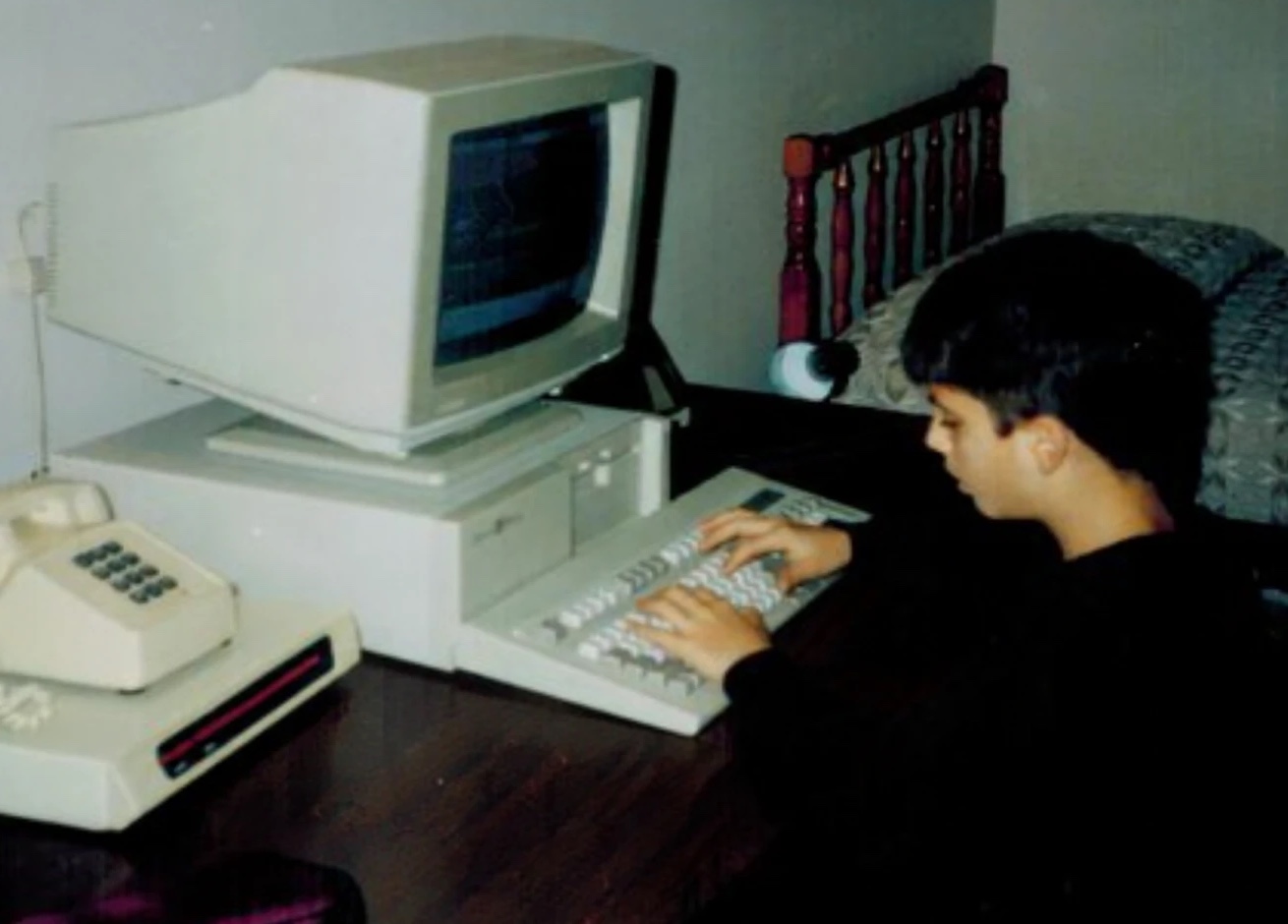 Michael at the family's 286 computer, 1987.
If you're of a certain age, you remember what that was like. No touchscreen, no friendly screen inviting you in. Mostly, a prompt and a blinking cursor, waiting for you to know what to type.
I didn't know what to type. So I learned. I took to that machine immediately, and in a way I have never stopped.
When I'd learned everything I could find on the screen, I turned the machine around and took it apart, more than once, to the dismay of my parents and my older brothers, to see what each part did and whether the computer still worked when it went back in. Usually it did.
What I couldn't have understood at seven, and understand now, is how much that machine asked of me. It didn't do things for me. I had to meet it more than halfway. Nothing was obvious. Every small victory came from trying, failing, figuring it out, and trying again, and every one of them felt enormous. That beige box was a tool, but it was also a training partner. It made me more capable precisely because it refused to make anything easy.
By twelve, I was the person my dad's business friends called when their computers acted up, and before long it was a business, MDL Computer Services. I spent my summers going from office to office, fixing computers and mostly teaching people how to use WordPerfect and Lotus 1-2-3. It turned out I could explain them. I'd learned all of it the same way, by taking it apart.
You probably have your own version of that. The instrument you couldn't play yet. The language that wouldn't stick. The first job where you had no idea what you were doing. It was hard, and the hardness was the point.
A floppy disk
In the summer of 1994, when I was fourteen, a friend introduced me to one of the cofounders of WINCOM, a new company bringing internet access to Windsor. I'd been around the edges of the internet already. A couple of years earlier I'd started my own bulletin board system, called Net@Work, which tells you I didn't yet know how to name things. But I had never seen the web.
He walked me over to a demo computer and switched it off, which struck me as a strange way to begin a demo. Then he slid in a floppy disk, turned the machine back on, and let the modem dial out. It was slow. He opened a web browser and typed in the first address I ever watched anyone visit, whitehouse.gov, and I sat in an oversized office chair while the page arrived one band of picture at a time.
I left with a copy of that floppy disk. At home, the modem screeched its way online, and I went straight to the web. Then I did to it what I'd done to the 286 computer. I took it apart. Every page carried its own instructions, one menu away, and I read them line by line, borrowed the tricks I liked, and built pages of my own to see whether they worked. Nobody taught me HTML. The web did, as long as I was willing to read it.
The reading paid off sooner than I expected. Before long, MicroAge, a Windsor computer training centre, asked me to teach a course in HTML, and at fifteen I stood in front of a room of mostly middle-aged adults, many of them new to technology, reading the same question on every face: are you sure you're supposed to be here, kid? A few classes in, the looks were gone. Everyone in that first group passed.
Junior Web Designer
In March 1998, I got my first job at a web design firm. The title was Junior Web Designer.
By then I'd been building websites for two years, and in April 1997, while I was in Grade 12, The Windsor Star put me on the front page of its business section under the headline "Finishing high school a part of teenager's business plan." We cut it out and laminated it.
The job came by way of my godfather, who introduced me to Mary-Ellen Foto, a co-founder of Outputs Web Design, one of the first web design firms in Windsor. The next day I was sitting across from Outputs' new owner, Ghassan Barazi, who looked at my work and asked if I could start the next week. I said yes before he finished the sentence. Then I went home, remembered that finishing high school was still part of the business plan, and had to call him back. He told me to come back in a month.
The web was young enough then that nobody was really a senior anything. We built pages by hand, one tag at a time. Connections were so slow that every image was a negotiation between what looked good and what would load before someone gave up and left. There were no frameworks to lean on and no tool that could tell you whether your idea was any good. You found out by shipping it and watching what happened.
I had good company. Marc Houle, one of the founders, took me under his wing. He showed me tools I'd never seen, how to script a simple web form, which was oddly hard in those days, and a set of Photoshop techniques I still use and still teach to junior designers. Marc could do nearly anything, from art and design to music and code, and these days he's better known for his electronic music. He was one of my first creative inspirations. He showed me how, and the work was still mine to do.
I got things wrong constantly. Pages broke. Layouts confused people. Clients asked for one thing and meant another. None of it felt like training at the time. It felt like work, and some days it felt like failing in public. But that is exactly what it was: repetitions, each one leaving a small deposit of judgment behind. Which layouts people understood without being told. What a client meant, as opposed to what they asked for. When something was finished, and when it only looked finished.
Same brief, every time
The repetitions kept adding up. In 1999 ICON Laser Eye Centers hired the whole Outputs team, and I became its webmaster. I built an online booking system so that someone thinking about LASIK could book a consultation without picking up the phone, and we streamed live laser eye surgery over the web to patients' families, just to prove it could be done.
Through the 2000s I started and ran digital agencies, carrying the strategy, the clients, and the P&L. When smartphones put software in everyone's pocket, I founded Touch Village, a mobile publisher, and brought a catalogue of apps and games to market. One of them, KitchenPad Timer, was featured in Apple's curated App Store lists. Later I served as Chief Product Officer at two venture-backed startups, WeCam and StoryShapr.
Different industries, different technologies, and the same brief every single time: make it easier. Fewer steps. Fewer decisions. Less effort between a person and the thing they want.
KitchenPad was the brief at its purest. It was a kitchen timer that opened on a drawing of an oven and a stovetop, crowed like a rooster when the chicken was nearly done and mooed for the beef, and ended up in the Los Angeles Times. Nobody had to be told how to use it, because everybody already knew how to use an oven. That was the whole design, and it was good design. It was also the opposite of the 286 computer.
That is what good product design has meant for most of my career, and I was good at it. I'm not embarrassed by that work. Removing needless friction is a kindness, and I would do most of it again.
But I'd be lying if I said I don't see my own fingerprints on the problem I'm about to describe. It took me a long time to notice that not all effort is needless, and that some of the friction we were so proud of removing was exactly where people's capability was being built.
One platform, three names
I joined Ventacity Systems, a small Portland, Oregon startup building software for smart buildings, to lead UX and product design. I spent nearly a decade on that one platform as it moved into Fujitsu General and on to Rheem Manufacturing, and along the way I built the first UX organization in the company's history and shaped design strategy for AIRSTAGE Cloud, its enterprise platform.
That decade gave me a front-row seat to something that now looks like a preview. Buildings were becoming intelligent systems. Software watched, predicted, and recommended, and the people running those buildings moved from operating them to supervising them. Underneath every screen we designed sat the same quiet question: when the system gets smarter, does the person using it get sharper, or just more passive?
I didn't have a name for that question yet. But it had started following me around.
Where the eye comes from
Which brings me back to that blank notebook, and the deal I'd told myself was fine because I could judge the work.
The eye I was relying on came from all of it. The 286 computer, the floppy disk, the classroom at fifteen, the hand-built pages, the agencies, the apps, the startups, the platform. Thirty years of doing the work the slow way. My judgment isn't a gift I was born with. It's a byproduct of effort, built one repetition at a time, and most of those repetitions I would happily have skipped if anyone had offered me a shortcut.
Nobody offered. Now everyone is.
That's when it hit me. The deal I had made with AI only worked because of a bill I had already paid. I'd done the reps. So what happens to the people who haven't?
The people coming up behind me
I had just hired a junior UX designer. I had just promoted someone to UX lead. Two people I believe in, both at the start of something, and I found myself thinking about how differently their careers are going to unfold from mine.
When AI hands them a polished draft, a plausible research summary, or a confident recommendation, what are they checking it against? They're talented. But they haven't had thirty years of repetitions, and the work AI does best is exactly the work juniors used to learn on: the first draft, the rough research, the routine screens, the hundred small decisions that slowly teach you which decisions matter.
That one landed hard. My job as their leader is to help them become better than me. And here I was, watching the bottom rungs of the ladder I climbed quietly disappear, while we asked them to start somewhere near the top.
I've seen what the bottom rungs can do. Late in the summer of 2002, Mary-Ellen Foto, by then teaching at St. Clair College, called to ask if I'd take over a class whose instructor had just left. It started in a few weeks, and there was no curriculum, no outline, no grading guide and no book, so I found one and built the course from scratch, second-guessing the decision more than once. I turned twenty-three that fall, only a few years older than my students, and most of them didn't get the book until a month in. They did the work anyway. Their final projects, fully interactive Flash websites, rivalled what the designers at my studio were producing, and one of them came to us as an intern and stayed.
Think about the person who taught you the most. Chances are they didn't do the work for you. They let you struggle, just enough, and they stood close while you did.
Still building
Then I thought about my kids, and the worry got a lot more personal.
I came to AI with three decades of capability already built. For me, the risk is that skills I already have could weaken if I stop using them. My kids face something different, because they don't have those skills yet. They are growing up with an assistant that can write the essay, solve the problem, summarize the book, and answer the question before they've finished asking it. Not occasionally. Every day, for the rest of their lives.
For them, the question isn't whether AI will wear down what they've built. It's whether they'll get the chance to build it at all, and whether, used well, the same tools could help them build it further than I ever did.
I don't say that as someone who wants to take the tools away. I was seven when a computer came into our house, and it shaped who I became. I want my kids to have powerful tools. But the 286 computer made me work for everything, and I became capable because of it. The tools my kids carry make almost nothing hard.
And if nothing is hard, where does capability come from?
One Saturday afternoon in April 2026, my kids, who are nine and seven, and I were at the kitchen table trying to build a marble run out of cardboard, tape, and whatever else we could find. It wasn't going well. The marble kept falling off the track, the tape wouldn't hold, and both of them were getting frustrated. My first instinct was to grab my phone and find a tutorial, and my daughter suggested exactly that. I put the phone down and asked for ten more minutes instead. There was some complaining, a few more failed attempts, and eventually a solution that wasn't particularly elegant. But it worked, and they'd figured it out themselves.
The frustration, the failed attempts, even the arguments about what to try next weren't getting in the way of the learning. They were the learning.
You were a kid once. Think about who you would have become if every hard thing had come with a skip button.
Why this is my work
I have asked myself whether I'm the right person to take this on. I'm not a neuroscientist or a psychologist, and Capably Human's research program exists precisely so that this work rests on research rather than on one person's convictions. But I keep arriving at the same answer.
For thirty years, my job was to take effort out of people's lives. I know how it's done: which friction to remove, how defaults shape behavior, how a well-designed product can make a person stop doing something without ever deciding to stop. The same tool can build the practice that makes people capable or quietly take it away, and which one happens comes down to how the interaction is designed. The people who understand how technology shapes practice have a responsibility to design for the first. That is a design problem, and design problems are the work I know best.
It is also something we can test. We're designing trials that compare different ways of working with AI to see which ones leave people more capable, and we'll publish what we find.
I also don't come to this as a skeptic. I've loved computers since I was seven. I use AI every day, and I'm not going to stop. I'm not interested in making anyone choose between their tools and their own minds. I want both.
A gym for the mind
We have been here before. For most of history, physical fitness was a byproduct of daily life. Then machines took the effort out of work, and we had to invent something deliberate to replace it: exercise, coaching, sports science, the gym. The gym was never a rejection of progress. We built it because engines, cranes, and elevators had taken over the lifting.
I believe the mind is approaching the same moment, and this time we get to design for it from the start. So I founded Capably Human to work out how people and AI can become more capable together. At its center is Capability Fitness: the lifelong development of the capabilities people use to reason and decide, learn, focus, create, and adapt. It isn't mental health, therapy, or treatment. It's capability. Capably Human studies it in the open.
It started on an ordinary night. In June 2026, at around ten, I sat down in my home office and began writing what would become The Capability Fitness Framework. The idea was simple: if technology is removing the mental effort that once came naturally through everyday life, we need to become intentional about developing those capabilities.
Our first product is Humably, and it's the gym: a place to assess, train, and be coached on the real work you already do with AI, built on one promise. Use AI to improve the outcome, and the person producing it. It runs on what we call rules of engagement: what to hand to AI and what to keep, when to trust it and when to challenge it, when to let it run and when to step in.
That night in March 2025, I closed ChatGPT, picked up a pen, and worked the problem through myself. Then I opened it again and asked it to challenge my thinking instead of doing the thinking for me.
A good spotter helps you lift more than you could alone, but doesn't lift the weight for you. They stand close, keep you safe, step in at the right moment, and let you do the work that makes you stronger. That's the kind of AI I want for my team. It's the kind I want my kids to grow up with. And, it turns out, it's the kind I need myself.
In 1986, a seven-year-old met a blinking cursor, and without meaning to, a machine started training him. It took me nearly forty years to see that clearly, and I only saw it because I noticed the training had stopped.
Maybe you've noticed it too.
My kids won't get a machine that trains them by accident. Neither will the designer I just hired, the lead I just promoted, or anyone starting out today. If we want tools that make us more capable, someone has to build them on purpose.
That's my origin story. The rest is the work.
Cite this piece
Capably Human Inc. (2026). An Origin Story (CH-0001). capablyhuman.com/CH-0001
© 2026 Capably Human Inc. Licensed under Creative Commons Attribution-NonCommercial-NoDerivatives 4.0 International (CC BY-NC-ND 4.0). You may share unchanged copies for non-commercial purposes, with the full citation above. Commercial use, including paid workshops, training, coaching or consulting, and use in paid products, courses, software, or AI products and datasets, requires a licence from Capably Human Inc.